
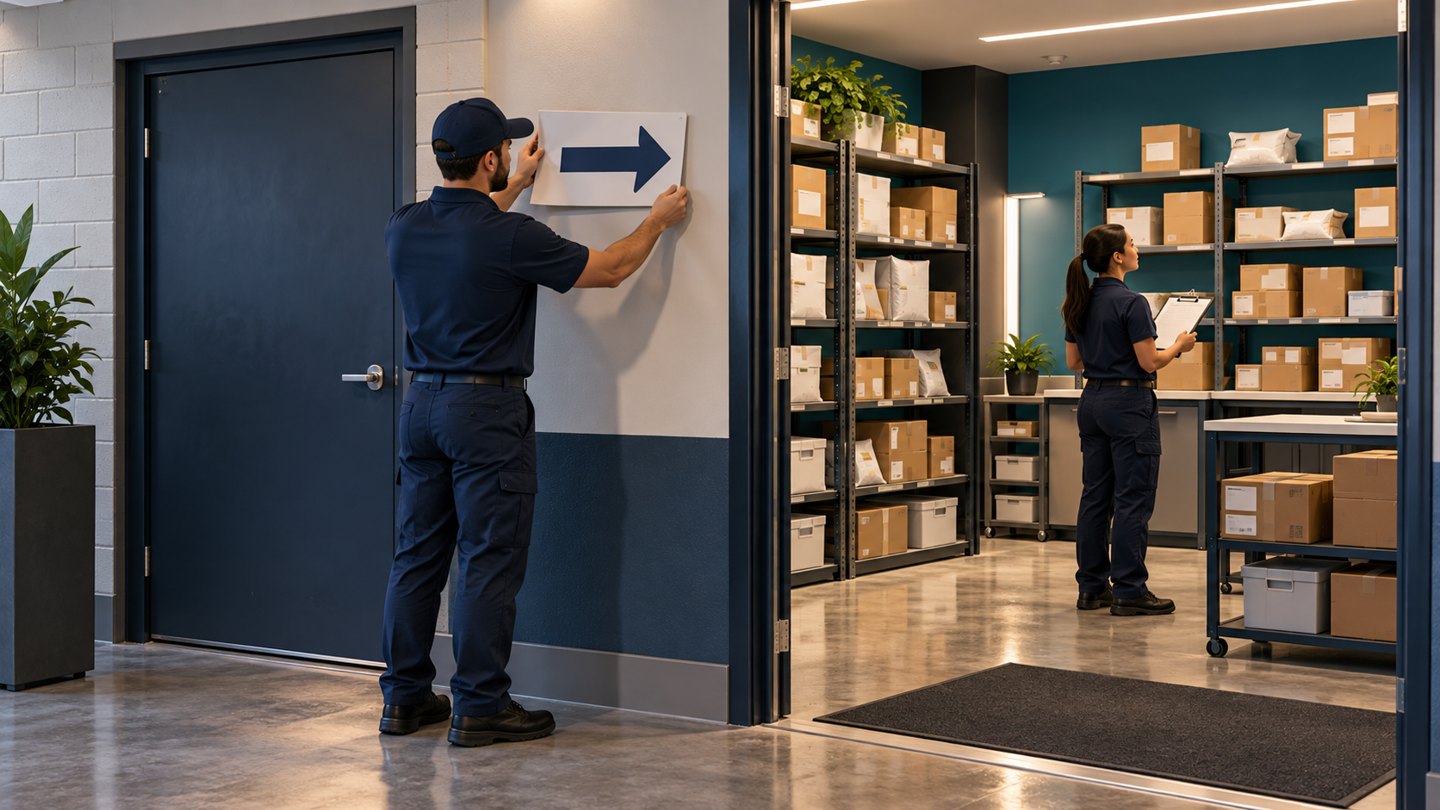
Give each reader one next action
A temporary sign saying “Package room moved” leaves several questions unanswered. Where should a resident ask for a parcel? Where should a carrier present a delivery? Is the new room open to visitors? If storage and service are in different places, naming the storage room can send people somewhere they should never have been directed.
This guide covers wayfinding during a planned, on-property package-room renovation. It concerns service directions, not a change of mailing address, carrier forwarding instruction or permission to leave parcels unattended. Emergency signs and evacuation instructions remain outside this process. Use the physical relocation runbook to establish the approved arrangement first.

Separate the three audiences
Residents and authorized collectors
Tell them where to request pickup, when staff are available and how to ask for help if the changed route is difficult. Say whether the ordinary pickup checks still apply. Do not publish a list of residents with waiting parcels or directions to individual shelves.
Carriers presenting deliveries
Identify the staffed presentation point and the permitted approach to it. State what to do if that point is unattended under the property’s approved arrangements. A sign should not invent a new drop location or imply that an unattended parcel has been accepted.
Authorized staff
Staff need the internal retrieval route, current storage references, responsible contacts and effective version of the instructions. Keep that detail in the approved staff channel. Separate access arrangements from a widely circulated operational map; a person’s need to understand the renovation does not necessarily mean they need entry credentials.
Make the time boundary visible
Write the date and time when the temporary instruction begins, including the local time zone when needed to avoid ambiguity. If the return date is not confirmed, do not print a firm reopening promise. Use a defined review or next-update time that someone owns.
Keep the service period distinct from the construction schedule. Renovation might finish on Friday while staff still need to inspect the room, return parcels and test retrieval. The reopening guide explains why those are separate decisions.
Maintain a small distribution list of notice locations: resident message channel, reception display, former room entrance, carrier approach and staff instructions. Record an owner for each. This list lets the coordinator replace conflicting notices when the plan changes without depending on everyone remembering where copies went.
Use templates with only approved facts
The following patterns are fictional drafting templates. Replace every bracketed field with a verified local fact, remove inapplicable sentences and route the notice through the property’s normal approval process. They are not messages already sent to residents or carriers.
Resident advance notice
Temporary package pickup during renovation. From [date and time], please request package pickup at [staffed service point] during [hours]. The usual pickup checks still apply. For help with the temporary route, contact [approved service contact]. We will confirm the return to the usual pickup point in a separate notice.
Sign at the former package-room entrance
Package service has moved temporarily. Please go to [staffed service point] via [approved public route]. Service hours: [hours]. If you need help, contact [service contact]. This instruction applies from [effective date and time]. Please do not enter the renovation area.
Carrier presentation notice
Package deliveries during renovation. Please present deliveries to staff at [approved receiving point] using [permitted approach]. If staff are unavailable, follow [the property’s approved contact or next-step instruction]. Do not leave parcels at the closed package-room door. Effective [date and time].
Correction when the return is delayed
Temporary pickup arrangements continue. Please continue using [staffed service point] during [hours]. The previously stated return date of [date] has changed. Our next update will be [confirmed update time or event]. Contact [service contact] if you need assistance.

Check what the notice reveals
Remove parcel photographs showing readable labels, resident names, item lists, storage maps, door codes and descriptions of unattended periods. Public directions usually need a service point and help route, not an explanation of where inventory is kept or how the room is secured.
The FTC’s information-protection guidance emphasizes limiting collection and access and safeguarding retained information. The notice review above is a practical application of those general principles, not an FTC-approved sign format or a claim that a notice alone protects the operation.
Keep useful access assistance available without asking residents to disclose a diagnosis in a public channel. Staff can explain the approved route or service alternative privately. Do not claim that a general-purpose sign proves a property meets accessibility requirements.
Walk the directions as a first-time visitor
Ask a colleague unfamiliar with the temporary arrangement to start at the ordinary resident approach. Can they identify the staffed point without entering the work area, following a storage label or relying on remembered door names? Repeat the test from the carrier approach if it differs.
Check the notice under the lighting and opening conditions that actually apply. Look for competing signs, a closed intermediate door or an arrow that becomes ambiguous at a junction. A digital message and a physical sign should use the same public name for the service point.
The temporary-space handover should already have resolved whether a route is permitted. Wayfinding testing checks whether instructions communicate that route; it does not authorize a new one.

A fictional correction before people arrive
At fictional Birch Landing, the draft notice says “Collect packages in the temporary storage room beside the gym.” The actual plan keeps that room staff-only and provides pickup at reception. During review, a covering colleague follows the draft directly to the storage door.
The coordinator replaces the wording with “Request package pickup at reception” and removes the storage-room reference from public copies. Staff retain the approved internal retrieval instructions. The carrier notice separately points to the staffed receiving point rather than copying the resident wording.
Two days later, the return date slips. The coordinator updates each entry on the distribution list and removes the superseded printed notice. No parcel records or access details are published to explain the delay. This is a fictional communication exercise, not a reported property result.
Retire the temporary message at the right moment
Coordinate the final notice with the live-service plan. Remove temporary directions only after the normal service point is ready and the replacement instruction is in place. Check the old temporary destination as well as the original room so a forgotten arrow does not create a second unofficial pickup point.
Keep any retained communication evidence according to the property’s policy, but remove obsolete public instructions from active use. A useful closeout confirms what people will read now, not only which notice the office most recently sent.