
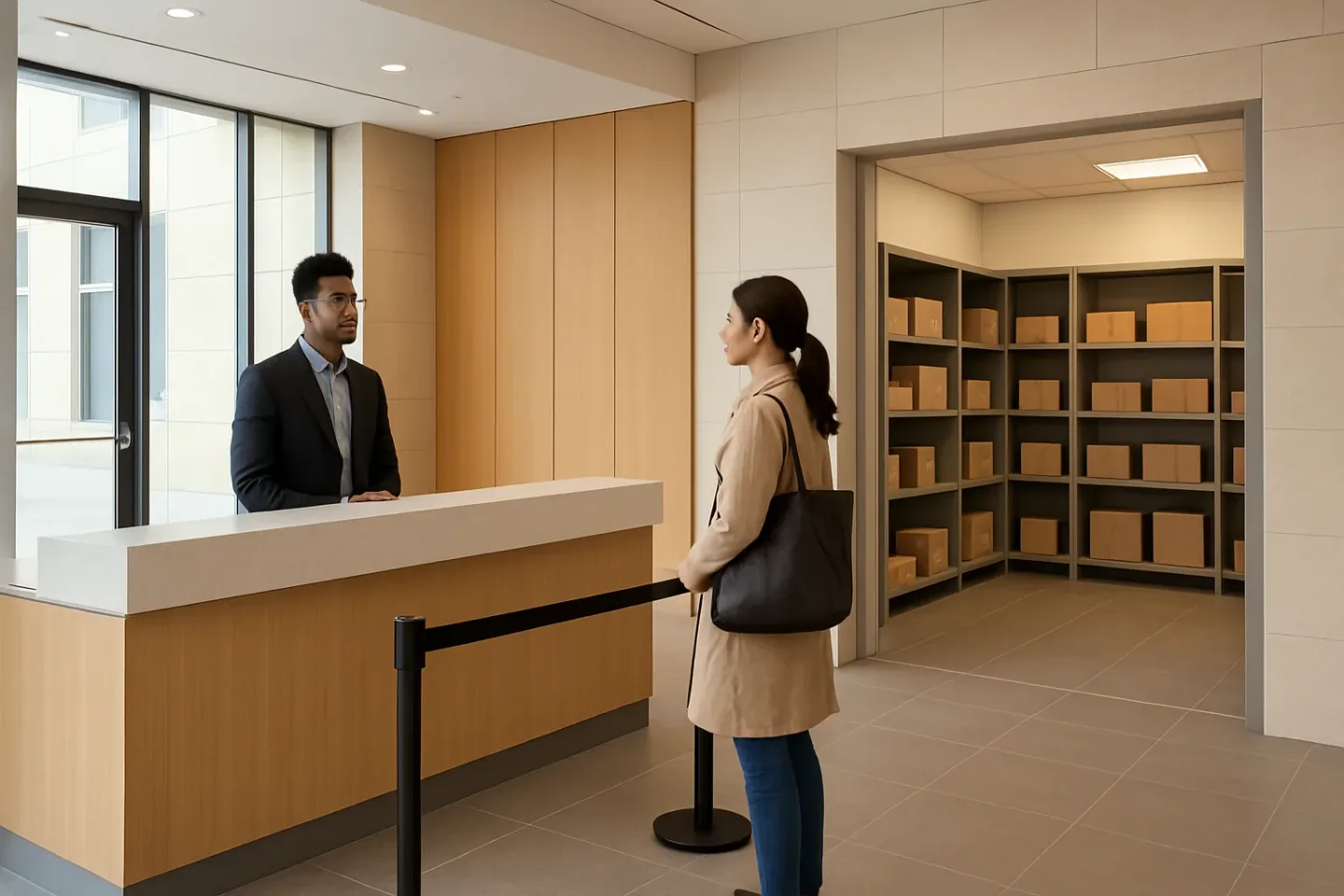
Package Room Fraud and “False Pickup” Prevention Without IDs, Photos, or Drama
Package room theft prevention often fails for one simple reason: the theft looks like a normal pickup. The person at the desk sounds confident, has a plausible story, and is counting on staff being busy enough to keep the line moving. Most losses in multifamily buildings are not “smash-and-grab” events—they are low-effort, opportunistic handoffs that happen when the process leaves room for interpretation.
The good news is you do not need to add high-friction steps like ID checks, resident photos, or confrontational interrogations to reduce false pickup claims. What you need is a small, predictable control set that staff can apply in under 10 seconds—consistently, across shifts—so the answer is the same no matter who is on the desk.
This guide takes a practical approach: one fraud pattern, one operational control. We will map common plays such as “I’m picking up for my roommate,” screenshot confirmations, badge tailgating, and urgency-based social engineering to simple moves like pickup tokens, supervised retrieval windows, doorline pauses, exception flags, and time-boxed holds. Each control is designed to be fast, staff-friendly, and defensible—creating chain of custody evidence without collecting more personal data.
The goal is not to turn your front desk into security theater. The goal is to remove ambiguity. When residents and would-be thieves both learn that pickups require the same quick validation every time (and that screenshots or stories do not shortcut the process), opportunistic theft becomes inconvenient—and it starts happening somewhere else.
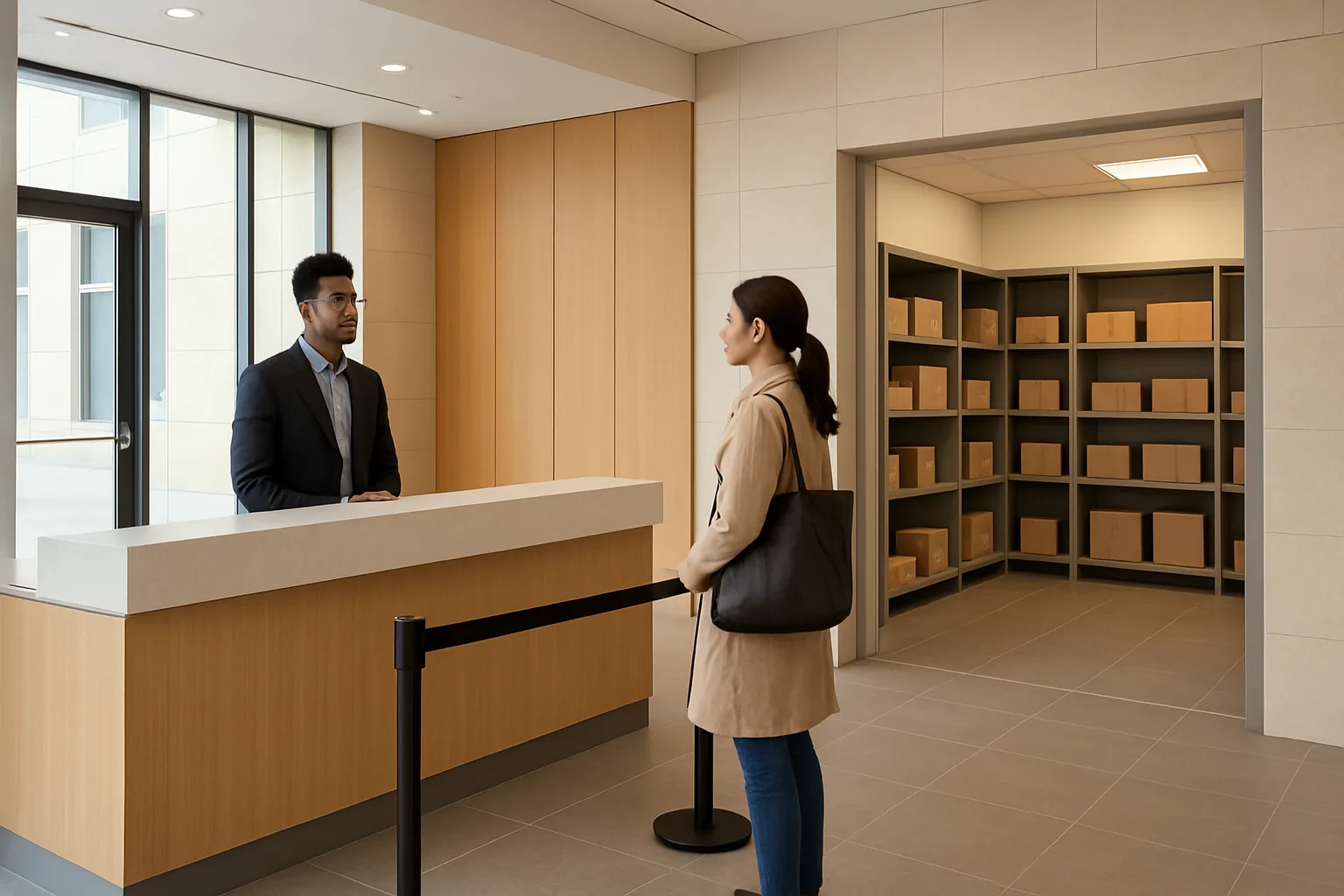
Why “False Pickup” Works: The 4 Opportunistic Patterns You Can Expect at the Desk
Package room theft prevention often fails for a simple reason: most “false pickup claims” are designed to exploit speed, courtesy, and ambiguity at the front desk. The person is not trying to break a lock; they are trying to get a well-meaning staff member to hand over property during a busy moment with just enough plausibility to avoid scrutiny.
For supervisors and security leads, the most useful way to reduce package room fraud controls is to train to repeatable patterns of behavior, not gut feelings. Opportunistic thieves tend to run the same plays because they work across buildings, shifts, and staffing levels. When staff can recognize the play, they can apply a consistent, low-friction response that does not rely on collecting IDs, taking photos, or escalating resident interactions.
The “surface area” is the handoff: the moment a package moves from building custody to a person standing at the desk (or inside the package room). That handoff is where social pressure, unclear authorization, and messy staging create openings—especially during peak delivery windows, shift change, and after-hours coverage.
- Train staff to identify the play (what the person is doing), not the person (how they look or sound).
- Assume attempts will cluster around busy times: carrier rushes, resident return hours, shift change, and when a new staffer is solo.
- Most incidents happen when staff are asked to “make an exception” in the moment without a clear, consistent rule to fall back on.
Pattern 1: Social engineering urgency ("I’m late, it’s for a tenant, just this once")
This is the classic “pressure + plausibility” attempt. The person creates urgency (“my Uber is here,” “I’ll miss my flight,” “I’m late for work”), adds a credibility hook (“I’m in 12B,” “I’m the dog walker,” “maintenance knows me”), and then asks for a small rule-bend (“just hand me the boxes,” “I’ll sign later,” “I forgot my phone”).
Why it works: it frames compliance as helpful and refusal as unreasonable. Staff are trained to keep the line moving and avoid conflict. When the package room process is even slightly unclear, urgency becomes the deciding factor.
What it looks like operationally: they try to keep staff from checking anything, they narrate a story while you’re moving, and they push for immediate handover of multiple items rather than a single, specific package. If challenged, they often redirect to emotion (“seriously?”) or authority (“I do this all the time”).
Pattern 2: Proxy pickup ("I’m picking up for my roommate/partner")
Proxy pickup is the most common “honest-sounding” false pickup claim because it mimics real life in multifamily buildings: roommates share errands, partners pick up deliveries, assistants run tasks. The attacker leans on that normalcy and assumes staff will default to convenience.
Why it works: many buildings have informal proxy behavior but lack a consistent method to verify authorization quickly. Staff end up improvising (“What’s their unit?” “Do you have the tracking number?”) which creates inconsistent outcomes and invites repeat attempts on the next shift.
What it looks like operationally: the person knows partial information (unit number, first name, maybe the carrier) but cannot match a specific package identifier. They may ask to “just grab anything for 14C” or “there should be two boxes,” pushing staff into rummaging or over-releasing. When told no, they pivot to “Can you call them?” to keep the interaction going until staff give in.
Pattern 3: Screenshot confirmations ("Here’s the email/text, see?")
Screenshots and saved images are a fast way to simulate proof. The person flashes a delivery notification, a text thread, or an email “pickup confirmation” on a phone, often angled so staff can’t read details closely. The goal is to create a visual shortcut: if it looks official, it must be legitimate.
Why it works: screenshots are easy to obtain and easy to fake. They also exploit the reality that staff do not have time to parse tiny details at the desk. In many buildings, residents have been conditioned to expect that showing a message is enough, so staff feel pressure to be “reasonable.”
What it looks like operationally: the person refuses to forward the message live, insists the phone has no service, or says the app “won’t load.” They may present a cropped screen that hides the recipient name/unit or timestamp. They may also show a message that confirms delivery, not authorization to release.
Pattern 4: Badge tailgating and casual access ("I’m with them")
Not every theft attempt happens at the desk. In buildings with a package room door, shelving alcove, or back hallway access, opportunistic theft often comes from casual access: slipping in behind a resident, following a carrier, or hovering near the boundary until someone opens the door.
Why it works: people are socially conditioned to hold doors and avoid confrontation. Staff may be occupied with the desk line and cannot monitor the doorline continuously. If the package area is within sight of the lobby, a thief can blend in and look like they belong—especially if they carry a tote bag or pretend to be on the phone.
What it looks like operationally: they position themselves near the package room entrance, follow closely behind someone with hands full, or wait for a moment when staff step away. If challenged, they rely on vague affiliation (“I’m with them,” “I live here,” “I’m just grabbing mine”) rather than a specific unit/package request. They often avoid the desk entirely.
Where the handoff breaks: unlabeled shelving, ambiguous authorizations, rushed shifts, and unclear exceptions
These patterns succeed when your operation gives them room to maneuver. The attacker’s advantage is not sophistication; it is your building’s ambiguity—especially when staff are trying to be helpful under time pressure.
Common breakpoints that increase false pickup claims and disputes include:
Unlabeled or loosely organized shelving: when staff must search by memory or visual guesswork, the process becomes conversational (“Is it a big box?”), which is easy to manipulate and hard to defend later as chain of custody evidence. Ambiguity invites over-release (handing out the wrong item) and under-logging (no clear record of what moved).
Ambiguous authorization norms: if “roommate pickup” is sometimes allowed, sometimes not, the rule becomes whichever staff member is on shift. Opportunistic actors will probe until they find the lenient moment.
Rushed shifts and peak-hour pressure: the front desk is optimized for throughput, which encourages shortcuts. Fraud attempts are timed to moments when staff are juggling calls, residents, carriers, and key requests.
Unclear exceptions: when staff do not have a quick, sanctioned way to handle edge cases (forgot phone, new resident, bulk pickup, after-hours), they improvise. Improvisation is where social engineering wins and where later disputes become “he said/she said” without chain of custody evidence.
The 10-Second Control Set: One Operational Move per Fraud Pattern
Package room theft prevention works best when the front desk does not have to “judge” people or invent rules on the fly. The goal is a simple mapping: each common fraud pattern triggers one consistent micro-control that staff can apply in under 10 seconds—without checking IDs, taking photos, or turning pickup into an interrogation.
These controls are designed to (1) remove discretion during pressured moments, (2) create clear chain of custody evidence through process, and (3) make opportunistic attempts fail quickly, so repeat offenders stop trying.
- Guiding rule: One fraud pattern equals one default control. No debates, no exceptions in the moment—exceptions are handled through a separate, flag-based path.
- Design for speed: If it takes longer than 10 seconds to explain, it will not stick during peak hours.
- Resident verification alternatives over identity checks: tokens, supervised retrieval, and live validation replace ID/face matching while still proving authorization.
Control for social engineering: Supervised retrieval windows (staff retrieves; resident waits)
Fraud pattern: urgency and pressure. The person is trying to rush a handoff: “I’m late,” “the resident is waiting upstairs,” “it’s just a quick grab,” “I know where it is.” The objective is to get you to point, unlock, or let them browse—creating a low-visibility moment for a wrong pickup.
10-second control: switch from “self-serve searching” to “staff retrieval at set windows.” Staff keeps the package-room boundary closed; the resident waits at a single pickup point while staff retrieves the item. The key is predictability: this is simply how pickups work, not a special response to a particular person.
How staff applies it quickly: confirm unit/name, say the standard line, retrieve, hand off only at the desk. No negotiation about “just stepping in for a second.”
Control for proxy pickup: Pickup tokens (single-use codes or scannable tokens tied to the package)
Fraud pattern: “I’m picking up for my roommate/partner.” Opportunistic thieves exploit shared living situations and the social norm that roommates help each other. If staff relies on conversational plausibility (“sounds reasonable”), false pickup claims become easy.
10-second control: require a pickup token that is tied to the specific package (not just the resident’s name). Tokens can be single-use codes or scannable tokens, issued to the intended recipient and shareable by them to a legitimate proxy. Staff does not need to evaluate relationships; they only validate the token.
How staff applies it quickly: ask for the pickup token first. If they do not have it, the next step is consistent: “Have the resident send you the token,” or “We can reissue a token to the resident on file.” This is a resident verification alternative that proves authorization without IDs or photos.
Control for screenshots: No-screenshot rule plus live token validation (email/text images do not count)
Fraud pattern: screenshot confirmations. Someone shows a screenshot of a delivery email, a text thread, or a building notification. Screenshots are easy to forward, edit, or reuse, and they pressure staff into treating “something that looks official” as proof.
10-second control: no-screenshot rule plus live validation. The desk accepts only (a) the live token entry/scan, or (b) a fresh, system-issued token validated at the moment of pickup. A static image is never treated as authorization.
How staff applies it quickly: acknowledge politely, then redirect: “Screenshots don’t work for pickup—please provide the live pickup token.” If the person insists, staff repeats the same rule and offers the same compliant path (token reissue to the recipient). This reduces arguments because the rule is about the format, not the person.
Control for tailgating: Doorline pause plus one-at-a-time threshold (no piggybacking into package areas)
Fraud pattern: badge tailgating and casual access. Someone follows behind a resident, delivery driver, or staff member with “I’m with them,” or slips into the package room when the door opens. The theft happens inside the room, away from the desk’s visibility and logs—making disputes hard to resolve.
10-second control: doorline pause and one-at-a-time threshold. If the package-room door is opening, staff uses a brief pause to prevent piggybacking: one person enters only when authorized, and pickups happen via staff retrieval whenever possible. Even in buildings where residents can access lockers or a room, this control establishes a clear “no shared entry” expectation.
How staff applies it quickly: step to the threshold, hold the line, and direct: “One at a time for package pickup—please wait here.” If someone is not the active pickup, they wait outside the boundary. The value is deterrence: opportunistic thieves stop trying when tailgating never works.
How to communicate the rules in one sentence at the desk (repeatable scripts)
Consistency is the deterrent. The fastest way to reduce front desk theft deterrence failures is to give staff a single sentence per control—short enough to repeat verbatim and neutral enough to avoid escalation. These lines also protect staff from being negotiated with, because the process sounds routine, not personal.
Use these as defaults; deliver them the same way every time, regardless of who is standing in front of you.
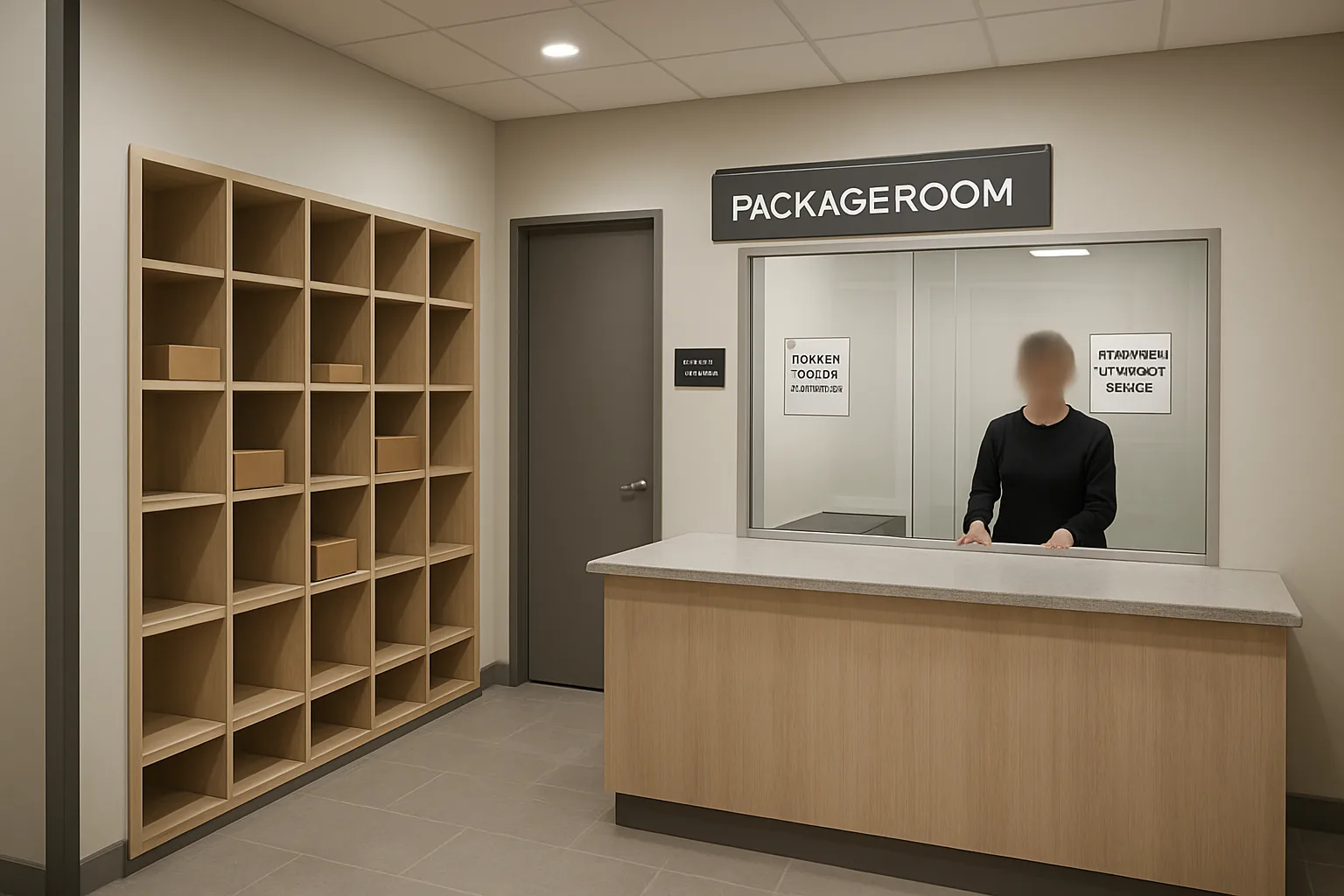
Make It Stick with “Exception Flags” Instead of Extra Screening
Low-friction controls fail when staff feel forced to improvise for “special cases.” The fix is not more screening; it is a shared, fast exception framework that any shift can apply the same way. Exception flags give staff a safe default response (“I can help, but I have to run it as an exception”) while quietly creating a deterrent: opportunistic thieves hate predictable process and visible accountability.
Instead of asking for IDs, photos, or long explanations, treat edge cases as short operational states. Each state triggers one simple action: hold, reissue a token, escalate, or schedule a supervised window. The goal is consistency across shifts, so the same play does not work on the “new person tonight.”
- Design rule: if it takes longer than 10 seconds to classify the situation, it is not an exception flag—it is a supervisor decision.
- Staff script to reduce pressure: “I can do that as an exception. It takes a moment and then we’ll get you sorted.”
- Every exception should end in one of three outcomes: token validated, time-boxed hold, or supervisor/security approval.
What counts as an exception (and what doesn’t)
An exception is any pickup request that breaks your normal handoff pattern (resident presents a valid pickup token; staff retrieves; token is validated; package is handed off). Exceptions are not “whatever the resident says.” They are a short list of common edge cases with predetermined handling steps.
What is an exception: anything that changes the requester, the timing, the identity details on the label, or the access conditions. What is not an exception: impatience, being “in a rush,” claiming familiarity with staff, or presenting a screenshot as proof. Those are exactly the moments when package room fraud controls should become more consistent, not more flexible.
Exception flags that take seconds
Use a small set of flags that staff can apply instantly—either in a log, a package tracking view, or a simple desk checklist. The flag itself is the control: it forces the next step (hold, re-verify, supervised retrieval, or escalation) without debate.
Recommended quick flags (and the default action)
Keep the list short and visible at the desk. If staff can memorize it, it will get used.
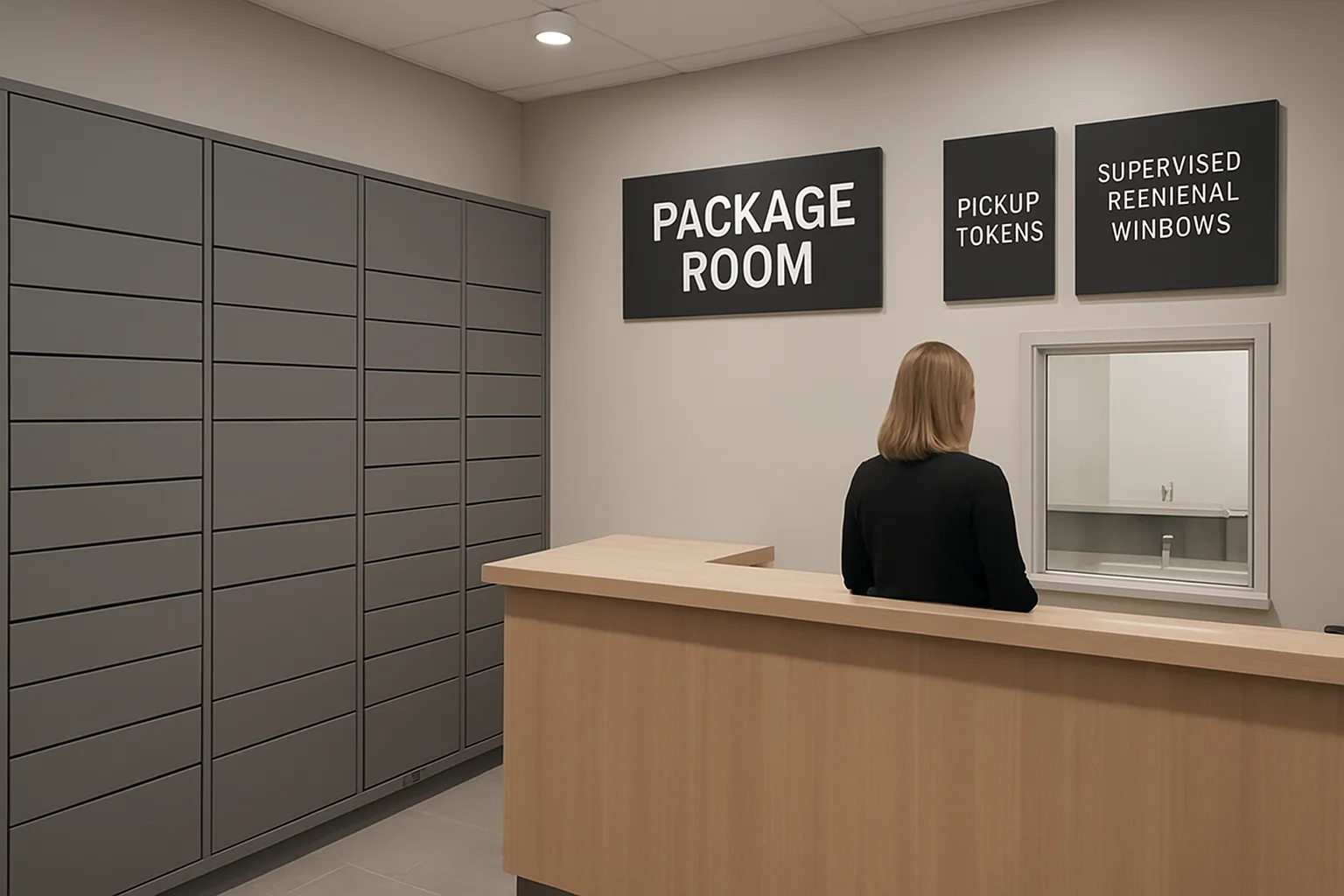
Chain of Custody Evidence Without Photos: What to Record in 5 Clicks (or One Line)
For package room theft prevention, the fastest win is not more screening. It is consistently capturing a small, repeatable record of what happened at handoff. A minimal chain of custody log deters opportunistic attempts (because the building can confidently say what occurred) and resolves disputes quickly without IDs, resident photos, or long desk interactions.
Think of this as process evidence, not personal data. If staff can prove the package was retrieved by the approved method (token validated, exception handled, supervised retrieval), most false pickup claims lose momentum immediately.
The minimum viable log: package identifier, time, staff initials, token validated, recipient name/unit, handoff method
A defensible chain of custody does not require a lot of fields. It requires the same fields every time. Whether you log in software or a paper binder, standardize on one short line per handoff (or the equivalent in a few taps).
Minimum viable entry (one line):
Package ID: carrier tracking last 6-8 (or internal label/QR number); Time: handoff time; Staff: initials; Recipient: name + unit (as provided in the package record); Token: validated yes/no (or token last 4); Method: supervised retrieval, locker, front desk counter, or approved proxy. If you need one more field, add Exception flag yes/no (not the story, just the flag).
Token events as evidence: issued, validated, expired, reissued
Tokens are powerful evidence because they create a simple event trail that is harder to argue with than a screenshot. Staff do not need to capture more resident information; they just need the token lifecycle to be consistent.
Treat token events like a light audit trail:
Issued: token created/sent for that specific package (or batch) and tied to the intended recipient or approved proxy. Validated: token checked live at pickup and marked used. Expired: token no longer valid after the time window. Reissued: when a resident reports they did not receive the token or it expired, the old token is invalidated and a new one is issued (with a note that it was reissued). The key is that reissues are visible; repeat reissues for the same unit or the same package are a useful signal for follow-up without accusing anyone at the desk.
What to do when a claim comes in: quick triage checklist (was token used? was exception flagged? who handed off?)
When someone says, "My package was picked up but I never got it," speed and consistency matter. A short triage prevents staff from improvising, and it avoids escalating friction with legitimate residents while still catching false pickup claims.
Use this quick checklist before you promise a refund, replacement, or carrier claim:
1) Confirm the package identifier: match tracking/label number and recipient name/unit to your log. 2) Check the handoff record: time, staff initials, and handoff method. 3) Token status: was a token validated, and when; was it reissued; did it expire unused. 4) Exceptions: was an exception flag used (proxy requested, name mismatch, after-hours, bulk pickup). 5) Who performed the handoff: identify the staff member or shift, then ask one factual question: "Do you recall anything unusual (pressure, proxy request, multiple packages)?" 6) If token was validated: treat it as a confirmed release and move to resolution steps (resident follow-up, internal review, camera review if available) rather than re-litigating the desk interaction. 7) If no token was validated but the package shows released: treat it as a process break, and focus on where the control failed (supervised retrieval not followed, access breach, incorrect logging) so it does not repeat.
Retention and privacy basics: keep it minimal, keep it consistent
Chain of custody evidence works best when it is both minimal and reliably present. You do not need IDs, photos, or personal descriptors. Avoid recording phone numbers, full email addresses, or notes about appearance. Stick to operational facts tied to the package and the process.
Practical retention approach: keep logs long enough to cover the realistic window for disputes (and your building policy), then purge routinely. Whatever period you choose, apply it uniformly. Consistency matters more than duration: a complete, predictable record for every handoff is what supports deterrence and dispute handling without adding resident friction.
How evidence changes behavior: preventing “try again on the next shift” fraud
Opportunistic package room fraud often relies on uncertainty: new staff, rushed shifts, vague handoffs, and "maybe it was released" ambiguity. A minimal chain of custody record changes that dynamic. When staff can instantly see that a token was validated at 6:12 pm by initials AB at the front desk counter, repeat attempts to re-claim the same package usually stop.
This is also a front desk theft deterrence tool for honest teams: it reduces blame-shifting and rumor-based investigations because the record shows whether the control was followed. Over time, patterns emerge without profiling residents: repeated reissues, frequent proxy attempts, and after-hours pressure flags become coaching and process-improvement inputs rather than arguments at the counter.
Implementation in a Real Building: Micro-Workflows, Signage, and Shift Training That Don’t Slow the Line
The fastest way to improve package room theft prevention is to make the “right way” the easiest way. That means designing a predictable flow (where residents stand, where staff move, where packages live), using simple tokens and labels, and training the same micro-steps across every shift so opportunistic attempts do not succeed just because the desk is busy.
This section turns the control set into a deployable routine: a single pickup point, staff-only retrieval, quick token validation, and lightweight logging. Done well, it actually speeds up peak-hour pickups by removing debates, screenshots, and ad-hoc exceptions.
- Goal: reduce false pickup claims and package room fraud controls failures without IDs, photos, or high-friction resident interactions.
- Principle: keep resident-facing steps short; move all complexity behind the desk (staging, tokens, holds, exception flags).
- Outcome: consistent, repeatable handoffs that create chain of custody evidence and strengthen front desk theft deterrence through environment design.
Physical flow: staging shelves, “staff-only” boundary, and a single pickup point
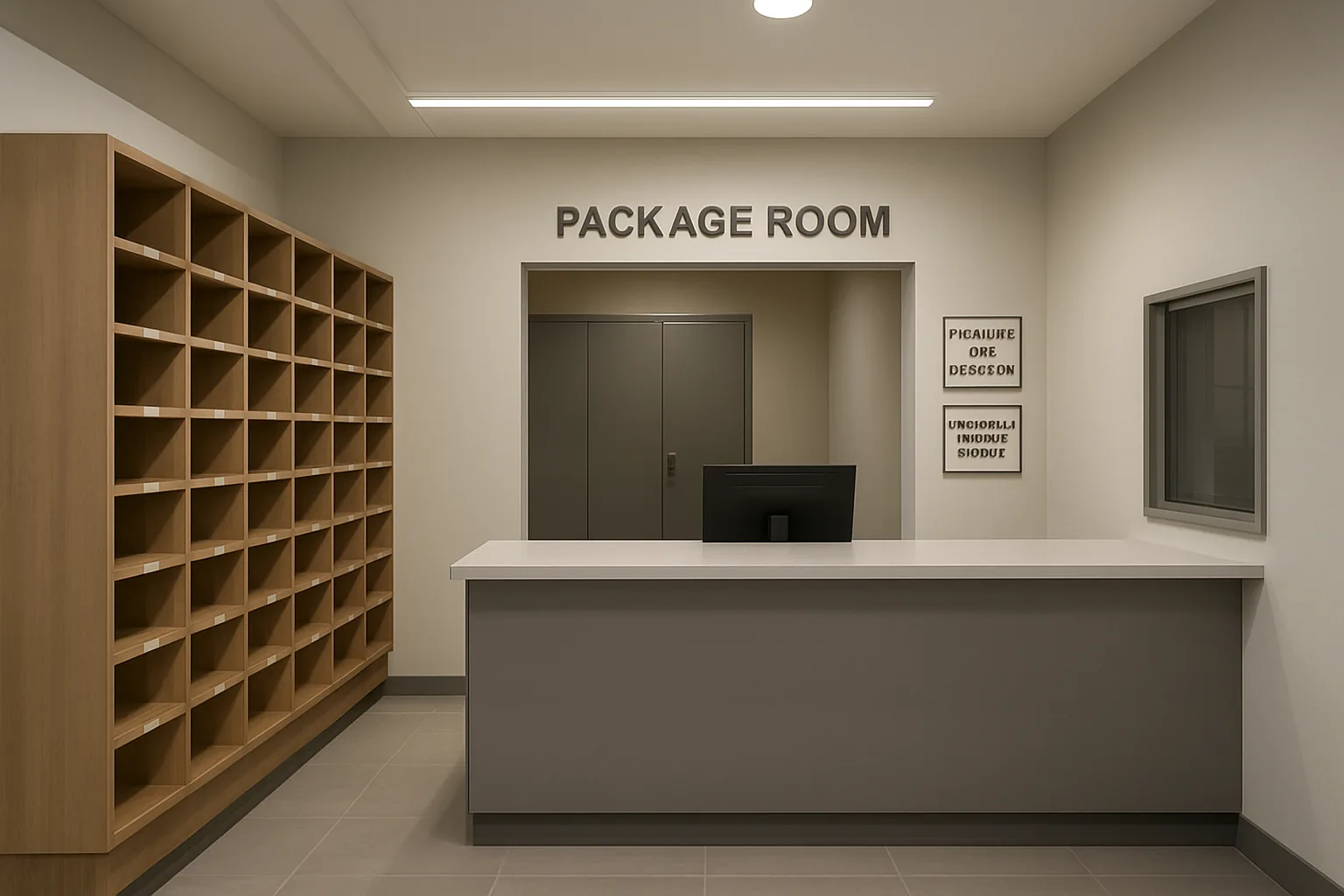
Set up the room so residents never need to enter the storage area to “help” or “look around.” Most badge tailgating and casual access happens when the package area feels like a shared space. Your physical layout should create one obvious pickup position and one obvious staff retrieval path.
Recommended layout (works even in tight lobbies):
1) A single pickup point at the desk (or just outside the package room door) marked as the only place handoffs occur. Residents queue here; staff stays behind the boundary and retrieves items. This eliminates rummaging, reduces mis-shelves, and removes “I already grabbed it” ambiguity during disputes (stronger chain of custody evidence). 2) A clear staff-only boundary: a floor line, stanchion, or door sign that makes it unambiguous that residents cannot cross. The cue matters because it gives staff a neutral policy to point to instead of negotiating. 3) Staging shelves organized for speed: sort by unit range or last name, with an “Intake / Not Yet Processed” shelf that is never used for pickups. That intake shelf prevents the common failure mode where something is handed out before it is labeled or logged—prime territory for false pickup claims and later confusion. 4) A dedicated “Exceptions / Holds” bin with a bright label. Anything flagged (proxy requested, name mismatch, after-hours release, bulk pickup) goes here so the next shift does not accidentally release it under pressure.
QR-label and token flow example: arrival label → token issued → supervised retrieval → validation → handoff
A fast, low-friction flow needs two things: (1) a physical identifier on the item that staff can find quickly and (2) a pickup token that can be validated live (not via a screenshot). You are not asking residents for IDs or photos; you are simply requiring the right token for the right package.
Example micro-workflow (peak-hour ready):
Arrival label: When a package is received, staff applies a simple QR label or short code sticker tied to the package record (or at minimum, writes a unique internal code plus unit). Place it on a flat, visible surface so it can be scanned or read without rotating the box. This reduces “wrong box” handoffs and supports chain of custody evidence without photos. Token issued: The resident receives a pickup token (single-use code or scannable token) associated with that labeled package. If residents pick up in person without prior token access (e.g., older residents, temporary phone issues), staff can generate a desk-issued token that expires quickly and is recorded as “desk-issued.” Supervised retrieval: Resident stays at the pickup point. Staff retrieves the item from shelving using the label or the package record. This is the key front desk theft deterrence move: it removes the opportunity to browse, claim, or swap items. Validation: Staff validates the token live (scan or enter code). Do not accept screenshots of emails or texts as proof; screenshots are easy to reuse and are the core of many false pickup claims. Live validation is the resident verification alternative that stays low-friction. Handoff: After validation, staff hands the package over at the single pickup point and marks it released to the named unit/recipient. If the resident is collecting multiple packages, validate and hand off in a repeatable order (one resident, one batch) so items are not mixed across people during rushes.
The 3-minute shift handoff checklist (what to check at start/end of shift)
Most theft and dispute spikes happen at shift changes: the new staff member inherits unlabeled packages, uncommunicated exceptions, and unclear “who already picked up” states. A short, consistent handoff checklist reduces those gaps and prevents the “try again on the next shift” pattern.
Start-of-shift (90 seconds):
– Confirm the staff-only boundary is in place (line/stanchion/sign) and the pickup point is clear. – Check the “Intake / Not Yet Processed” shelf: anything there should not be released until labeled and entered. – Check the “Exceptions / Holds” bin: review the top 3–5 items and any notes (proxy requested, name mismatch, after-hours). – Verify token validation method is working (scanner/entry device available; if down, use a temporary manual token procedure and note it). – Count any high-risk items loosely (e.g., visible electronics boxes) and ensure they are not accessible from the resident side of the boundary. End-of-shift (90 seconds): – Clear the pickup area of any packages staged for release that were not picked up; return them to shelves or the holds bin with a note. – Ensure all newly arrived items are labeled or moved to Intake with a “not processed” note—never leave unlabeled items in pickup-ready shelving. – Note any repeated pressure attempts (urgent social engineering, screenshot arguments, proxy claims) so the next shift expects the same person to return. – Confirm exceptions are clearly flagged and time-boxed (when the hold expires, who can override). – Quick status to supervisor (verbal or written): “Any token issues, any exceptions, any suspicious repeats.”
Signage that prevents arguments: “No screenshots,” “Tokens required,” “One at a time,” “Staff retrieves packages”
The purpose of signage is not to shame residents; it is to prevent on-the-spot negotiation that slows the line and creates inconsistent exceptions. Clear, neutral signs give staff a script they can point to, which reduces friction while strengthening adherence to package room fraud controls.
Place signs at three points: building entry to package area, the pickup point, and the staff-only boundary. Keep them short and operational.
Sign text examples (use any subset that fits your building): – “Pickups: staff retrieves packages. Please wait at the pickup point.” – “Tokens required for pickup. Screenshots cannot be accepted.” – “One at a time beyond this point.” (paired with a floor line or stanchion) – “No entry to storage area without staff.” – “Proxy pickup requires a valid pickup token.” (avoids arguments like “I’m picking up for my roommate”) – “Items on Intake shelf are not yet available for pickup.” (prevents pressure to release unlabeled packages) Pair the sign with one consistent sentence staff can use: “We can hand it over as soon as the token validates—screenshots do not validate, so we need the live code.” This keeps resident verification alternatives simple and repeatable without requesting IDs or photos.
Pilot plan: start with peak hours, measure exceptions, tune hold times and scripts
You do not need a building-wide overhaul on day one. A short pilot during the busiest windows is enough to prove the controls reduce disputes and speed up lines. The key is to measure what creates friction (exceptions, token issues, and repeat attempts) and tune the workflow until staff can execute it in under 10 seconds per handoff step.
Pilot approach (2–3 weeks):
1) Choose the highest-risk window: typically weekday evenings (e.g., 5–8 pm) and weekend midday. Apply the full flow only during those hours at first: single pickup point, staff retrieval, live token validation, no screenshots, one-at-a-time threshold. 2) Track only what you will use: count exception flags by type (proxy requested, name mismatch, urgent pressure, after-hours, bulk pickup) and note repeat attempts (same person, same story). This quickly reveals which false pickup claims are most common in your building. 3) Tune hold times: if many residents legitimately cannot access tokens in the moment, allow a short “time-boxed hold” (e.g., return item to holds bin; release only after a fresh live token is presented). Adjust the duration to balance convenience and risk. 4) Refine scripts: collect the phrases that trigger arguments (“but I have the email,” “I’m with them,” “the last person let me”) and replace them with one-line, policy-based responses. Consistency is your strongest front desk theft deterrence. 5) Expand coverage: once staff reports they can maintain pace at peak hours, extend to all hours and all staff. If needed, add a quick refresher at the start of each shift for one week to lock in habits. When you pilot this way, you reduce opportunistic theft without adding high-friction screening, and you strengthen chain of custody evidence simply by making every handoff look the same.
Next Step: Turn This Into a Building-Wide Pickup Standard
If you want a low-friction way to reduce false pickup claims, improve front desk theft deterrence, and keep chain of custody evidence clean (without IDs or photos), adopt a single control set for every shift: token-required pickups, supervised retrieval, a no-screenshot policy with live validation, doorline anti-tailgating, and exception flags with time-boxed holds. Standardize the scripts, post simple signage, pilot at peak hours, and review exceptions weekly until the process is stable.
A Low-Friction Standard That Makes Theft Harder Than It’s Worth
The most effective package room fraud controls are not complicated—they are consistent. When every shift uses the same 10-second micro-checks, you stop rewarding the two things opportunistic thieves rely on: staff discretion under pressure and process gaps between people, hours, and entry points.
A simple operating standard—supervised retrieval, token-based pickup, a no-screenshot rule with live validation, a doorline pause to prevent tailgating, and quick exception flags with time-boxed holds—does more than reduce loss. It creates clear chain of custody evidence for disputes, protects staff from being “talked into” exceptions, and deters repeat attempts from people who cycle through shifts looking for a weak moment.
To roll this out without slowing service, start small and make it measurable: pilot during peak pickup windows, train the scripts and exception flags, review where the line bogs down, then tune hold times and escalation paths. Within a short cycle, you will have a process residents can understand, staff can execute quickly, and supervisors can audit without guesswork.