
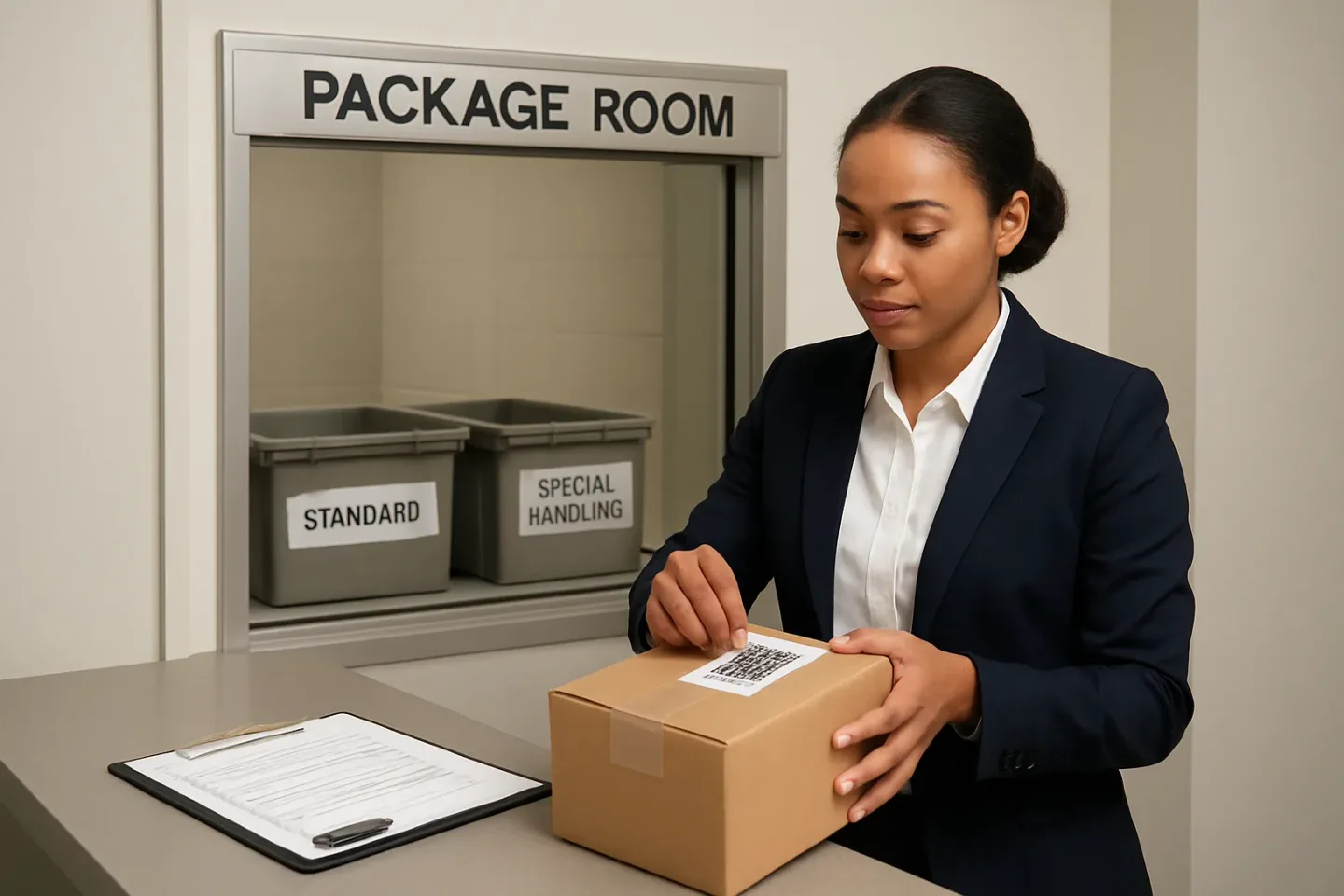
When “Just Take the Package” Turns Into a Liability Problem
Most apartment package workflows are built for boxes you can scan, shelve, and hand back out. The trouble starts when a delivery has special handling baked into it: controlled substances, perishables, or adult-signature requirements. Those categories turn a routine front-desk moment into a risk decision, often under pressure from a carrier, a resident, or a line forming behind them.
A pragmatic high liability package handling policy apartment building teams can actually follow has one goal: accept only what you can store safely and hand off with a clear chain-of-responsibility, and decline or redirect the rest—consistently, politely, and without improvising legal interpretations. This playbook is designed for front desk, concierge, and security teams who need a defensible SOP that reduces resident conflict while staying operationally realistic.
Inside, you will find three things you can put into use immediately: a fast decision tree (accept/decline/redirect) with scriptable triggers; minimal documentation rules that protect your team without creating an unmanageable “chain-of-custody”; and resident-facing language that sets boundaries in plain English. The aim is not to make you a pharmacy, a refrigerated warehouse, or an ID-checking service. It is to make sure your controlled substances delivery policy, perishable package procedure, and adult signature deliveries front desk practices match what your building can safely do every day. When they do, the package room stops being a liability trap and becomes a predictable service again.
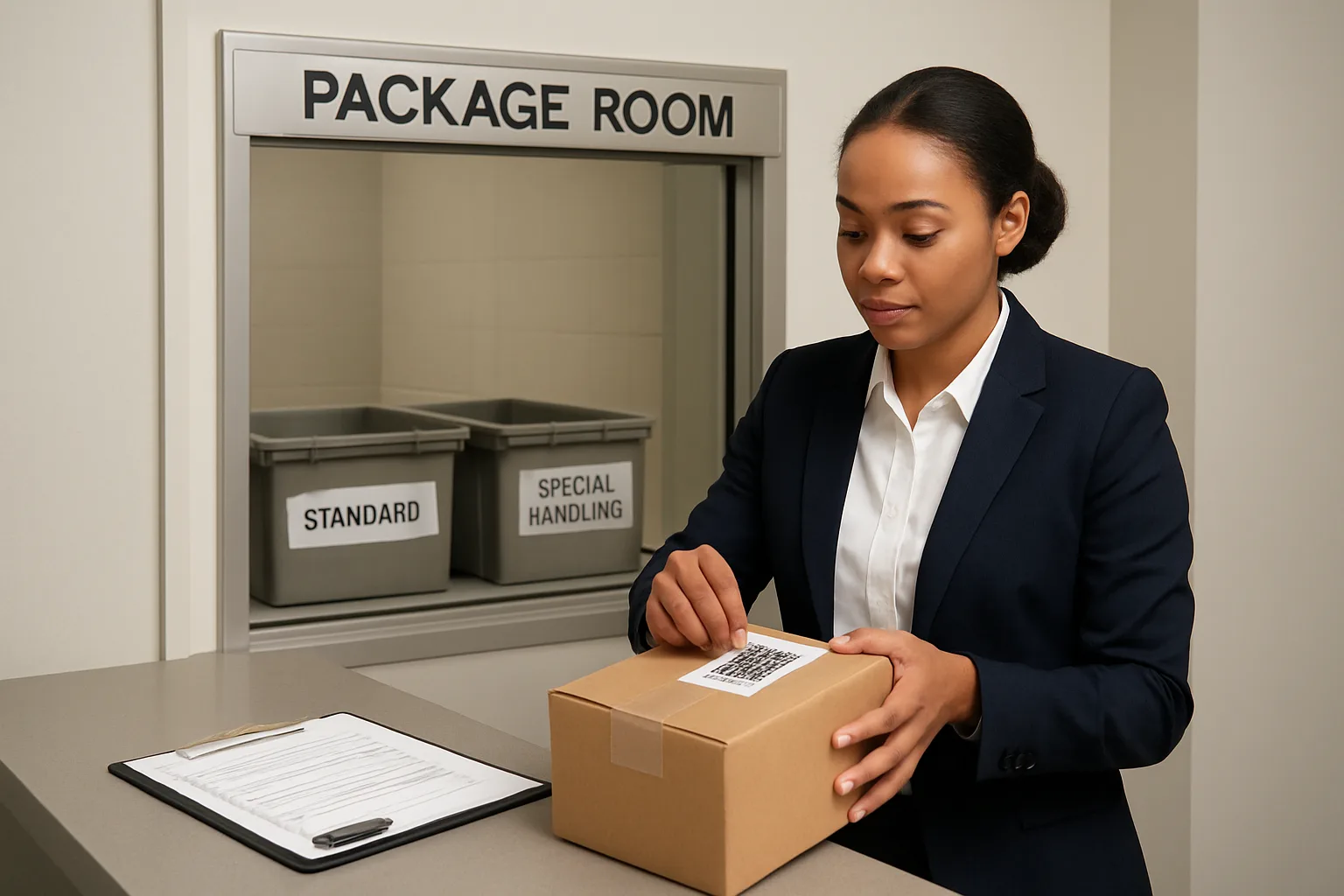
Define “High-Liability” Packages and the One-Page Policy Boundary
Most apartment package workflows are built for standard parcels: receive, log, store, release. “High-liability” packages break that model because they introduce one or more of the following risks: restricted handling requirements, time/temperature sensitivity, identity verification, or unclear special instructions that staff cannot safely validate at the door.
The goal of a high liability package handling policy apartment building teams can follow is not to “cover every scenario.” It is to draw a clear, repeatable boundary so staff are never pressured into signing, storing, or verifying something the building cannot control. This section defines the categories and gives you a one-page boundary statement you can put in front of residents, carriers, and your own team.
- Operating principle: Accept only what you can store safely and release with a clear chain-of-responsibility from carrier to building to resident.
- Keep it one page: if staff can’t remember it during a busy delivery rush, it won’t be followed.
- Be consistent: exceptions create resident expectations and turn one-off favors into “policy.”
High-liability categories: controlled substances, perishables, adult-signature, and “unknown special handling”
Define “high-liability” by observable handling signals, not by what you think the contents are. Staff should not guess or debate legality or medical necessity at the desk. Instead, train them to react to cues on the label, the carrier device prompt, and the condition of the package.
Use these four categories because they map to real front-desk decisions: accept, decline, or redirect. They also align with what carriers typically flag and what residents dispute most often.
High-liability categories (building-facing definitions staff can apply in seconds)
Controlled substances (building-side): Any delivery that is labeled or prompted by the carrier as medication requiring special handling, includes pharmacy branding that indicates regulated fulfillment, shows “controlled substance” language, requires ID verification, or includes “signature required, adult/ID” tied to a pharmacy/dispensary. If it’s ambiguous, treat it as high-liability until clarified by the carrier prompt or manager.
Perishables: Any package marked perishable, refrigerated, frozen, “keep cool,” “temperature sensitive,” “fresh,” “food,” “meal kit,” “flowers,” or any parcel with gel packs/dry ice indicators, insulated packaging, or a noticeable odor. If your team cannot store it appropriately and release it quickly, it is high-liability.
Adult-signature: Any package where the carrier device prompts “adult signature,” “21+,” “ID required,” “age restricted,” or similar. This is high-liability even if the box looks ordinary, because the risk is in signing/ID handling and the dispute that follows if policy isn’t followed exactly every time (adult signature deliveries front desk is where inconsistency becomes conflict).","Unknown special handling: Anything with unclear instructions (e.g., “do not leave unattended,” “deliver to addressee only,” “time definite,” “keep upright,” “hazmat/ORM-D markings,” damaged/leaking parcels, or hand-written notes from the sender). If staff cannot comply with the instruction as written, it’s high-liability and should be declined or redirected.
Policy boundary statement: what the building does and does not do
Your one-page boundary statement should be written as “we can” and “we cannot” rules. Avoid legal language and avoid listing every possible item. Focus on actions staff take (sign, store, refrigerate, accept cash, verify ID).
Below is copy-ready language you can adapt as your high liability package handling policy apartment building summary. Keep it short enough to print and post behind the desk.
One-page boundary (copy-ready)
What we do: We accept standard carrier deliveries for residents, log them, store them in the designated package area, and release them to the resident (or an authorized pickup person per building rules).
What we do not do: 1) We do not sign for adult-signature or ID-required deliveries unless the resident is physically present to sign with the carrier. 2) We do not verify identity or collect/record ID numbers for delivery purposes. 3) We do not accept packages that require refrigeration/freezing or special temperature control unless the building has a designated, monitored storage solution and an active pickup window policy. 4) We do not accept cash-on-delivery (COD) or handle payments/tips for carriers. 5) We do not open packages, confirm contents, or interpret medical/legal requirements.
If we cannot safely store or properly release a package under these rules, we will decline it at the door or redirect it (e.g., carrier hold location, reattempt when resident is available, delivery to unit where permitted).
Storage constraints: when lack of secure/temperature-controlled space becomes an automatic decline
High-liability items become “building liability” the moment they are inside your control. That means your storage capabilities should drive the acceptance rules, not resident preferences or carrier pressure.
Set two non-negotiable constraints and make them automatic triggers: (1) secure storage and (2) appropriate conditions (including temperature and access control). If either is missing, the correct action is decline or redirect—no improvising.
Practical triggers for automatic decline/redirect
Use straightforward triggers staff can apply without debate:
Secure storage trigger: If the only available storage is an open lobby, unsecured shelf, or a room that multiple third parties can access without logging, do not accept high-liability items. This includes adult-signature packages and any package that would predictably cause a dispute if lost.
Temperature trigger: If you do not have a designated temperature-controlled process (even a small monitored refrigerator with access control and a short hold window), do not accept perishables marked “refrigerate,” “frozen,” “keep cold,” or parcels with obvious cold-pack indicators. A standard package room is not “temperature controlled” just because it is indoors.
Resident responsibility line: delivery timing, tracking, and pickup expectations
Resident conflict drops sharply when the policy makes responsibility explicit and measurable. The building can control storage and release processes; residents control ordering choices, delivery timing, and responsiveness.
Include a resident responsibility line that is firm but neutral. It should tell residents what to do differently (schedule, use hold-at-location, be available for signature) instead of only telling them what you won’t do.
Copy-ready resident responsibility language
Residents are responsible for: 1) choosing delivery options that match building capabilities (no refrigeration means schedule perishables to arrive when you can pick up immediately), 2) monitoring carrier tracking and delivery alerts, 3) being available for any required signature/ID check, and 4) retrieving packages promptly within posted pickup windows.
If a delivery requires adult signature/ID or special handling we cannot provide, please select a carrier hold location, a staffed pickup point, or schedule delivery for a time you will be present.
Where this policy lives: lease addendum vs. house rules vs. front desk SOP (and why consistency matters)
High-liability packages create “policy by anecdote”: a resident remembers the one time a staff member made an exception and treats it as a guaranteed service. To prevent that, the same boundary must exist in three places—each written for its audience.
You are not trying to create a legal document; you are trying to prevent contradictory instructions. When the lease, house rules, and desk SOP say the same thing in plain language, staff can enforce it without arguing and residents can predict outcomes.
Recommended placement (simple and consistent)
Lease addendum (or lease rules attachment): One paragraph that states the building is not responsible for restricted, perishable, or signature-required deliveries that cannot be safely accepted or stored; residents must arrange appropriate delivery methods. Keep it general and evergreen.
House rules / resident handbook: The one-page boundary statement plus practical examples (adult signature, perishables, COD, damaged/leaking). This is where residents look first when they are frustrated.
Front desk SOP: The operational version with the category definitions and automatic triggers (secure storage/temperature). Keep it action-based: what to accept, what to decline, what to redirect, and who can approve an exception. This is also where you align your chain-of-responsibility package room expectations so staff know when custody starts and ends.
The Decision Tree: Accept, Decline, or Redirect (With Scriptable Triggers)
Use this decision tree at the door to prevent “in-the-moment” exceptions that create liability. The goal is speed and consistency: identify the category, apply accept/decline triggers, then either store with a clear handoff path or redirect back to the carrier/resident without debating contents.
Treat every decision as a chain-of-responsibility package room question: Can we store it safely, control access, and hand it to the right person within a realistic pickup window—without staff signing or verifying identity beyond policy? If not, decline or redirect.
- 30-second flow: Identify category -> Check storage + pickup window -> Check signature/ID requirements -> Check condition (leaks/damage) -> Confirm recipient -> Accept OR Decline OR Redirect -> Log only the outcome + reason code.
- Default stance for high-liability: if you cannot confidently meet storage/security/signature rules, redirect to the carrier’s hold option or require delivery to the resident directly.
- If a carrier pressures staff: repeat the policy trigger (signature required, no secure storage, unclear recipient) and offer a redirect option; do not negotiate new rules at the door.
Step 1: Identify package category at the door (label cues, carrier notes, signature prompts, temperature indicators)
Quick identification prevents accidental acceptance. Staff do not need to interpret contents—only apply observable cues and carrier prompts.
Use a simple category tag set in your log (e.g., Standard, Adult-Signature, Perishable, Controlled/Regulated, Unknown-Special, Damaged/Leaking) so the next step is automatic.
Accept criteria: secure storage available, no staff signing beyond policy, pickup window can be met
Accept only when all three are true: (1) storage is appropriate and available (locked bin/cabinet or monitored room), (2) the carrier does not require staff to sign or verify ID outside your rules, and (3) the resident can realistically pick up within your defined window for that category.
If any condition fails, do not “make it work” by improvising storage (e.g., behind the desk, in an office, near HVAC, in a common fridge, or with a personal phone call promise). That turns a defensible SOP into ad-hoc liability.
Decline criteria: adult signature required with resident unavailable; controlled-substance indicators; leaking/damaged; perishable without appropriate storage; unclear recipient
Decline is a service action, not a confrontation. Use clear triggers so staff don’t feel they must justify or explain the underlying product.
Decline immediately when: signature is required and resident is not present; any controlled-substance/regulatory cue appears (carrier note, “ID required,” pharmacy program markings) and your policy is to not accept; the package is leaking, damaged, emitting odor, or appears unsafe; it is perishable without approved temperature control; recipient name/unit is missing, mismatched, or not in resident list.
Redirect options: to resident’s unit, locker system, scheduled delivery window, carrier hold-at-location, return-to-sender
Redirect keeps delivery moving while protecting the building. Always offer one clear next step rather than a vague “we can’t take it.”
Preferred redirect order: (1) deliver directly to resident/unit if carrier allows and resident is available, (2) approved locker system that supports the category and access control, (3) scheduled delivery window when the resident will be present, (4) carrier hold-at-location/pickup point, (5) return-to-sender when no safe alternative exists.
Operational tip: keep a short reference sheet at the desk with major carriers’ “hold for pickup” language so staff can confidently suggest it without arguing policy details.
Carrier-facing mini scripts: calm, consistent language that avoids legal interpretations
Use neutral, repeatable phrasing. Do not describe items as “medication,” “drugs,” “alcohol,” or “illegal.” Refer only to carrier prompts and building handling limits.
Decline (signature): “Our policy doesn’t allow staff to sign for adult-signature items. Please deliver when the resident is present or place it on carrier hold for pickup.”
Decline (storage): “We don’t have approved secure/temperature-controlled storage for this category, so we can’t accept it at the desk. Please deliver directly to the resident or hold it at your pickup location.”
Edge case handling: “resident told me you always take these,” third-party couriers, and after-hours drops
Resident claim: “I understand. Our handling rules changed/are enforced consistently for safety. If it needs a signature or special storage, it must go to the resident directly or carrier hold.” Then proceed with redirect—no exceptions at the desk.
Third-party couriers (food/marketplace): treat as perishable/unknown-special by default. If the courier cannot confirm recipient availability and you cannot store safely, redirect to resident contact in-app or mark undeliverable—do not accept “leave with front desk” requests outside policy.
After-hours: if secure storage/access control is reduced (fewer staff, locked package room, no manager on duty), tighten accept criteria. For high-liability categories, default to redirect or next-day scheduled delivery when the resident can receive it. If something is left unattended anyway, isolate it, mark as “Found/Unattended,” log minimal details, and notify a supervisor for next-step instructions.

Minimal Documentation Rules That Still Protect You
A high liability package handling policy apartment building teams can actually follow depends on one thing: documentation that is consistent, fast, and limited to what you genuinely use to run the operation. Over-documenting (or attempting a full chain-of-custody like a pharmacy) often backfires because it is hard to sustain on a busy desk, and inconsistency creates arguments later.
The goal is a minimum viable record that proves three operational facts: what showed up, where it went, and who handed it off. That is enough to support a chain-of-responsibility package room model without turning your staff into investigators. Keep the workflow scan-based and checklist-driven so the same steps happen even during peak delivery hours.
- Principle to train on: If you cannot do it every time in under 30 seconds, it is not part of the minimum record.
- Principle to repeat: Record what you observed (label prompts, damage, location), not what you assume (contents, value, legality).
- Principle for disputes: Your log should answer “where was it stored and when was it released,” not “who is at fault.”
The “minimum record” checklist: date/time, unit, carrier, package category tag, storage location, who handled it
For special-category items, you want the same data points every time. Think of this as your operational receipt, not a legal file.
Minimum record fields (use exactly these and resist adding more unless leadership approves):
1) Date/time received (auto-generated if possible) 2) Recipient identifier (unit number plus last name initial, or unit only if your building policy prefers minimal PII) 3) Carrier (USPS/UPS/FedEx/Amazon/other) 4) Package category tag (Perishable, Adult-signature, Controlled/Restricted, Unknown special handling, Standard) 5) Storage location (Package Room shelf, Locker number, Secure cabinet, Redirected to unit, Declined) 6) Staff handler (initials or staff ID of the person who accepted/logged it).” To keep it defensible, make the category tag selection a required step for any non-standard package. That supports your controlled substances delivery policy and perishable package procedure without needing narrative notes.
When to photograph (and when not to): damage, leaks, missing labels, or policy-exception approvals
Photos can help, but only when they capture a clear, objective condition that will matter later. If staff take photos randomly, you risk privacy complaints and inconsistent evidence (some packages have photos, others do not).
Use a simple trigger rule: photograph only when one of these is true:
– Visible damage (crushed box, torn envelope, broken seal) before you move it to storage
– Leaking, wet, strong odor, or contamination concern
– Label issue (missing unit number, unreadable name, multiple labels with different recipients)
– A policy exception was approved (for example, manager-approved temporary acceptance of an adult signature deliveries front desk item while resident is en route). Keep the photo to the exterior label and condition only. Do not photograph the contents, prescription details, or any paperwork inside the package. If a package is clearly private or medical in nature, default to “no photo unless damaged/leaking,” and keep the frame tight on the shipping label and outer condition.
QR-label and package-room logging examples: fast scan-in, shelf/bin assignment, scan-out to resident
Speed and consistency come from making logging a physical process: scan, label, place, and later scan out. A QR-label workflow is ideal because staff are not re-typing long tracking numbers under pressure.
Example scan-in flow (30 seconds):
– Scan or enter carrier tracking number (if you do not capture tracking numbers, scan your internal QR label instead)
– Select unit and category tag (Perishable, Adult-signature, Controlled/Restricted, Unknown)
– Print/apply an internal QR label to the outside of the package (never over the carrier label)
– Assign a storage spot: “PR-A3” (Package Room, Shelf A3) or “CAB-2” (Secure cabinet bin 2)
– Place the item in that exact spot immediately (no “temporary counter pile”).
Example scan-out flow (handoff):
– Resident arrives (or authorized pickup per building policy)
– Staff retrieves the item from the logged location
– Scan the internal QR label to mark released
– Record who released it (staff ID) and method (Front desk pickup, Locker pickup, Delivered to unit).
This is how you create a practical chain-of-responsibility package room: every movement is a scanable event tied to a location, not a story typed after the fact.
Exception logging: one-line reason codes for declines/redirects (for pattern spotting, not legal defense)
High-liability problems usually show up as patterns: the same carrier repeatedly attempts adult-signature drop-offs when residents are at work, or a resident repeatedly orders perishables to a building with no refrigeration. Track exceptions with short reason codes so you can coach staff and adjust resident guidance without writing paragraphs.
Keep exceptions to one line with a code plus optional 5–10 words. Recommended reason codes:
– DECLINE-ASIG: Adult signature required; resident not present
– DECLINE-PERISH: Perishable; no appropriate storage
– DECLINE-CTRL: Controlled/Restricted category; building does not accept
– DECLINE-DMG: Damaged/leaking on arrival
– REDIRECT-UNIT: Sent to unit/attempted unit delivery
– REDIRECT-HOLD: Carrier hold requested/return to station
– REDIRECT-LOCKER: Placed in locker system (if available)
– UNKNOWN-RECIP: Recipient unclear/missing unit
Train staff to avoid legal phrasing (for example, do not write “illegal drugs” or “narcotics”). Stick to operational triggers aligned with your policy boundary: signature requirement, storage constraints, label ambiguity, or damage.
Privacy boundaries: what staff should never record (contents assumptions, health info, ID numbers)
Special-category deliveries create temptation to “explain” what happened in detail. That is where privacy and resident trust get damaged. Your log must stay neutral and minimal.
Never record:
– Assumptions about contents (for example, “cannabis,” “steroids,” “medication,” “alcohol”) even if you suspect it
– Health information (pharmacy names, diagnosis clues, prescription numbers)
– ID numbers (driver’s license number, passport number) or photos of IDs
– Cash amounts, declared value, or personal commentary about the resident
– “Proof” narratives (for example, “resident was angry,” “carrier was rude”) unless an incident report is separately required by management.
If your adult signature deliveries front desk workflow involves checking ID, record only: “ID verified per policy” (yes/no) and who verified it (staff ID). Do not store the ID details.
Retention and access: simple retention window and who can view logs (limit gossip and disputes)
Retention should match the reality of package disputes: most issues surface quickly. Keeping logs forever increases privacy risk and makes it easier for sensitive information to spread internally.
A simple operational standard:
– Retain routine package logs for a defined, short window (commonly 30–90 days) based on management preference and local requirements.
– Retain incident-related records (damage/leak photos, manager-approved exceptions, loss claims) longer only when there is an active dispute, then close and purge per policy.
Access rules matter as much as retention. Limit log access to: property management, front desk supervisors, and designated security/concierge leads. Do not allow casual browsing “to help a friend find a package.” If a resident asks for records, provide only what is necessary to resolve the delivery question (received time, location, released time) without exposing staff names beyond initials or revealing other residents’ information.
This keeps the documentation defensible: it proves the operational chain-of-responsibility package room steps while respecting resident privacy and keeping the process sustainable.
SOPs by Category: Controlled, Perishable, and Adult-Signature Deliveries
Use the category-specific SOPs below as your on-shift playbook. The goal is consistent handling that matches a high liability package handling policy apartment building teams can actually follow: clear accept/decline/redirect rules, short pickup windows, and a simple chain-of-responsibility package room process (scan-in, secure hold, scan-out).
When in doubt, staff should avoid interpreting what an item “is” and instead follow observable triggers: label requirements, signature prompts, temperature needs, leaks/odors, and whether secure storage is available right now.
Controlled substances delivery policy (building-side): default decline/redirect, how to handle ambiguous labels, and how to respond to resident pushback
Purpose: keep staff out of the role of pharmacist, compliance officer, or custodian of regulated items. Your safest default is decline/redirect unless your ownership and counsel have explicitly approved acceptance and storage controls.
Default rule: if the carrier indicates a controlled substance, regulated medication, or any “signature + ID” compliance requirement that staff cannot legally or operationally perform, decline or redirect to the resident or carrier hold location.
Controlled substances: step-by-step (desk and package room)
1) Identify at the door (do not open the package). Treat as controlled if any of these are present: carrier prompts for ID verification, “adult signature required,” pharmacy/clinic shipper branding, temperature/gel packs paired with medical/pharmacy labeling, or courier notes like “Rx,” “medication,” “controlled,” “ID required.”
2) Apply the policy trigger. If ID check, restricted delivery, or resident-only signature is required and the resident is not physically present: decline/redirect on the spot. Do not sign “as agent,” “as concierge,” or “front desk” if the delivery terms imply resident identity verification.
3) Redirect options (in order): (a) carrier hold-at-location/pickup point, (b) reschedule for a resident-present window, (c) deliver directly to the unit with resident answering (carrier completes their own verification), (d) return-to-sender per carrier procedure. Staff should not suggest workarounds that bypass carrier rules (for example, “leave it anyway”).
Controlled substances: if the label is ambiguous
If it might be medication but is not clearly labeled and does not require ID/signature, treat it as “unknown special handling” rather than guessing contents. Use building capability as the deciding factor:
– If the package can be stored securely and you can meet a short pickup window (same day), you may accept as a standard package with a “high-liability: unknown” tag and immediate notification to the resident.
– If you cannot store securely (open-access room, no controlled-access cabinet), redirect/decline. The storage constraint is your cleanest, non-legal reason code.
Controlled substances: storage, pickup window, and resident pushback
Storage rule (if accepted at all): hold only in a locked cabinet or restricted-access room; no placement on open shelves. Limit handling to one trained role per shift (for example, concierge lead or security supervisor) to maintain chain-of-responsibility package room control.
Pickup window: same-day pickup preferred; if not collected by a fixed cutoff (for example, end of shift or end of business day), initiate redirect/return workflow per your policy.
Resident pushback script (keep it operational, not legal): “We cannot accept or store items that require ID verification or restricted delivery. Please choose carrier hold/pickup or schedule delivery when you can sign directly.”
Perishable package procedure: accept-only-if rules, time limits, temperature notes, and “no refrigeration” language
Purpose: prevent spoilage claims and food-safety disputes. Perishables are a customer experience issue until they become a liability issue, so your procedure should be simple and consistent: accept only when you can store safely and notify immediately.
Accept-only-if rules (all must be true): (1) the package is intact (no leaks/odors), (2) there is an available designated perishable hold area (even if unrefrigerated), (3) the resident can reasonably pick up within a short window, and (4) staff are not required to refrigerate, freeze, or monitor temperature.
If any accept condition is not met, redirect/decline and tell the carrier to attempt resident delivery or hold at location. Do not “make room” in staff refrigerators or personal coolers; that creates inconsistent handling and higher expectations next time.
Perishables: step-by-step (receiving through release)
1) Identify perishable indicators: insulated box, gel packs/dry ice markings, “perishable,” “refrigerate,” “keep frozen,” grocery service branding, or noticeable condensation/cold pack weight.
2) Quick condition check: look for damage, wetness, stains, swelling, strong odor, or loose contents noises. If any are present, treat as damaged/leaking (see that SOP below).
3) Decide storage capability: if you do not have temperature-controlled storage, you may still accept only if your policy permits unrefrigerated short holds and the package is clearly marked for immediate pickup (for example, “perishable: 2-hour hold”). Otherwise redirect/decline on capability grounds, not on guesses about contents safety.
Perishables: storage, notification, pickup windows, and timeouts
Storage rule: place in a clearly labeled perishable zone (separate from standard parcels) to avoid accidental overnight holds. Keep it off carpet and away from electronics; use a tray or bin that can be sanitized.
Notification: send immediate resident notification that includes the pickup deadline in plain language (example: “Perishable delivery received at 3:10 PM. Please pick up by 5:10 PM. Items not collected by the deadline may be redirected or returned.”).
Pickup window: set a short, uniform window (commonly 2–4 hours while staffed). Whatever window you choose, apply it consistently across all residents and shifts. Do not extend informally at the desk; use the escalation ladder for exceptions.
Perishables: “no refrigeration” boundary language (internal and resident-facing)
Internal rule: staff do not open, repackage, add ice, or transfer contents. Staff do not accept instructions like “put it in the fridge” or “freeze it until I get home.”
Resident-facing boundary line: “We do not refrigerate or freeze deliveries. If your order requires temperature control, please schedule delivery for when you can receive it or use a carrier pickup location.”
Adult signature deliveries front desk: no-sign policy options, resident-present signing workflow, and carrier hold alternatives
Purpose: adult-signature items (often alcohol, vaping, certain high-value goods) create identity verification and dispute risk. Your SOP should remove staff from being the verifying adult unless your building has explicitly chosen and trained for that role.
Policy choice A (recommended for most buildings): no-sign for adult signature items. Staff do not sign, do not present ID, and do not accept packages that require adult signature unless the resident is present to sign directly with the carrier.
Policy choice B (only if formally approved and trained): staff may facilitate delivery only when the carrier’s process allows it and the resident is physically present to complete the signature/ID step. Staff facilitate access, not verification.
Adult signature: step-by-step (no-sign baseline)
1) Identify the requirement: carrier device prompts for “Adult Signature Required,” “ASR,” “21+,” or driver requests ID/signature at desk.
2) Check resident presence: if the resident is not physically present in the lobby/desk area to sign with the carrier, decline/redirect. Do not accept “I’ll sign later,” “leave it in the package room,” or “concierge can sign for me.”
3) Redirect options: (a) carrier hold-at-location, (b) reschedule for a resident-present window, (c) deliver to unit when resident answers, (d) return-to-sender. If your building uses appointment delivery windows, offer the next window rather than negotiating ad hoc.
Adult signature: resident-present signing workflow (if allowed)
If your property allows resident-present signing, keep staff role limited and consistent:
– Staff confirms the resident is present and is the named recipient (for example, by asking them to state unit number and last name).
– The carrier performs ID check and obtains the resident’s signature directly. Staff do not handle the ID, do not record ID numbers, and do not sign on the resident’s behalf.
Damaged, leaking, or odor cases: isolate, document minimally, notify carrier/resident, and when to call supervisor
Purpose: prevent hazards, avoid contamination of the package room, and reduce arguments about “who caused” the damage. The key is quick isolation and minimal documentation without speculating about contents.
Immediate action: do not bring a leaking/odorous package into the main package room. Place it in a designated isolation tray/bin in a low-traffic area (or keep it with the carrier if still at the door). If there is visible liquid, use gloves if available and avoid contact with other parcels.
Minimal documentation: log date/time, unit, carrier, and a neutral condition note (example: “Box wet/leaking at receipt” or “Strong odor noticed at receipt”). Photograph only the exterior damage and label; do not open the package to “confirm” contents.
Damaged/leaking: carrier and resident handling rules
If the carrier is present: ask the carrier to take it back or mark as damaged and follow their process. This is often the cleanest chain-of-responsibility outcome.
If the carrier has already left: notify the resident immediately with pickup instructions and advise them to contact the carrier/sender for claims. Keep language neutral: staff observed damage; staff did not assess contents.
When to call a supervisor immediately: unknown chemical smell, smoke, hissing, powder residue, heavy leakage, or any situation that raises safety concerns. If your building has a safety protocol for suspicious packages, follow it and limit discussion to observable facts.
After-hours and weekend constraints: cutoff times, unattended package room rules, and security patrol handoff
Purpose: your risk rises when staffing drops. High-liability items should not “coast” overnight in an uncontrolled environment because that is when spoilage, loss, and disputes happen.
Cutoff times: set a clear daily cutoff after which high-liability categories are automatically redirected/declined unless a trained authorized role is present to secure them. For example, after the concierge desk closes, adult-signature and perishables should not be accepted into the building workflow.
Unattended package room rule: if the package room is accessible without staff supervision (even with cameras), do not store controlled or adult-signature items there. Perishables also should not be held there beyond the short pickup window.
After-hours: security patrol handoff (if applicable)
If security is the only after-hours presence, define one of two models (choose one and stick to it):
Model 1: Security does not accept high-liability deliveries at all. They redirect carriers to hold/reschedule. Security only responds to resident questions by repeating the redirect options.
Model 2: Security can accept only into a locked cabinet with a quick scan-in and a strict pickup deadline. Access to that cabinet is limited (one key-holder per shift) and every handoff is logged (scan-out to resident). If the cabinet is full or unavailable, revert to Model 1.
Escalation ladder: when front desk can decide vs. when a manager approval is required
Purpose: remove hesitation and prevent “policy shopping” where a resident pressures the newest staff member for an exception. The ladder below keeps decisions fast at the desk while protecting the building from inconsistent exceptions.
Front desk can decide (no approval needed):
– Decline/redirect any adult-signature-required delivery when resident is not present to sign with the carrier (no-sign baseline).】【Note: This list continues below in bullets for quick reference.】
Resident-Facing Language That Sets Boundaries Without Picking Fights
High-liability deliveries create conflict when expectations are vague: residents assume the desk can sign, store, refrigerate, or “just hold it,” while staff are trying to follow a defensible high liability package handling policy apartment building teams can execute consistently. The goal of resident-facing language is to be predictable and specific: what the building will do, what it will not do, what residents should choose at checkout, and what happens when a package arrives that falls outside policy.
paragraphs
Use the same wording across notices, your resident portal/app, the package room sign, and the front-desk scripts. Consistency reduces “but they did it last time” arguments and makes declines feel like policy, not personal discretion.
- House rule for all messaging: describe process, not intent. Avoid debating what a package “is” (medicine, alcohol, controlled, etc.). Focus on what is required (signature, refrigeration, special handling) and what your building can safely provide.
- Keep it short enough that residents actually read it: one paragraph summary plus a link/attachment to the FAQ.
- Use the same three verbs everywhere: accept, decline, redirect. If you use those terms publicly, staff can mirror them at the desk.
One-paragraph building policy summary (plain English)
Copy-ready version (edit for your building’s actual hours and storage options):
Our team can accept standard deliveries for residents during staffed hours and place them in the package room for pickup. For safety and accountability, we may decline or redirect deliveries that require an adult signature, require refrigeration or temperature control, appear damaged/leaking, or require special handling we cannot provide. If a delivery needs your signature or immediate receipt, please schedule it for when you are home, use carrier hold-at-location/pickup options, or route it to an approved pickup point. Packages are held for pickup according to house rules; unclaimed items may be returned or managed per carrier instructions.
Front-desk scripts for: decline, redirect, and “we can’t store perishables”
The point of a script is not to sound robotic; it is to remove improvisation under pressure. Keep your tone neutral, use one reason, and give one alternative. Avoid legal conclusions (for example, do not say “this is a controlled substance”). Stick to observable requirements (signature required, perishable, refrigeration needed, damaged, unknown recipient).
Decline script (adult signature required, resident not present):
I can’t sign for adult-signature deliveries on behalf of residents. The carrier can attempt delivery to your unit, reschedule, or hold it for pickup. If you’d like, I can note that you prefer a reattempt after 5 pm, but the carrier controls the delivery options.
Front-desk scripts (continued)
Decline script (special handling or unclear recipient):
We can’t accept items that require special handling or that aren’t clearly addressed to a current resident. Please ask the carrier to verify the label or contact the sender to update delivery details. If you can provide a corrected tracking update showing your name and unit, we can accept it like a standard delivery if it meets our storage rules.
Redirect script (to resident’s unit): (for carriers who can deliver to the door)
Front-desk scripts (continued)
This package can’t be stored at the desk/package room under our policy. Please deliver it to the resident’s unit or follow your hold/reattempt process. If the resident is available, they can meet you in the lobby to accept it directly.
We can’t store perishables script (no refrigeration or time limit exceeded):
We don’t have refrigerated/temperature-controlled storage. To avoid spoilage, we can’t accept perishable deliveries for later pickup. Please deliver to the unit when the resident is home, or use a carrier hold/pickup option.
Resident proactive tips: scheduling deliveries, using carrier hold, choosing pickup locations, delivery instructions examples
Proactive tips work best as a short checklist in your portal/app (and as an auto-reply when residents ask “Can the desk sign for this?”). Keep it practical and choice-based.
Copy-ready tips (use as a message or FAQ section):
1) If your delivery requires an adult signature, schedule it for when you will be home, or choose hold-at-location/pickup at checkout. The front desk cannot sign for you.
Resident proactive tips (continued)
2) If you are ordering perishables (meal kits, groceries, flowers, refrigerated items), choose a delivery window when you can pick up immediately. We do not refrigerate packages.
3) Add accurate delivery instructions. Example: “Deliver to Unit 1207. Do not leave in lobby. If signature required, call resident.”
4) Use the carrier’s tools: delivery appointment, access code notes (if permitted), text alerts, and hold requests. Your tracking number is your fastest source of updates; the desk may not have additional detail beyond what is scanned into the package room log/QR-label system.
Signage for package room and desk: what staff can accept and what must go to resident directly
Signage should be short enough to read while walking. Put the long version in the FAQ, not on the wall. The goal is to prevent arguments at the desk by setting expectations before a resident orders.
Package room sign (copy-ready):
Package Room Rules (Quick Guide)
Signage (continued)
We accept standard deliveries during staffed hours and log them for pickup.
We cannot accept for storage:
– Adult-signature required deliveries (must be received by resident) (adult signature deliveries front desk policy)
– Perishable/refrigerated or temperature-sensitive deliveries (perishable package procedure)
– Damaged, leaking, or odor-emitting packages
– Items not clearly labeled with resident name and unit
If your delivery falls into these categories, please schedule for when you are home or use carrier hold/pickup options. Ask the desk if you need help locating carrier pickup settings (we can’t change delivery terms on your behalf).
Desk counter tent (ultra-short version)
We can log standard packages. We do not sign for adult-signature deliveries and we do not store perishables. Please plan delivery windows accordingly.
Dispute de-escalation: how to acknowledge frustration without admitting fault or making promises
When residents are upset, the highest-risk response is improvisation: exceptions made in the moment become the new “standard,” which undermines your chain-of-responsibility package room controls and creates inconsistent handling. Use a three-step pattern: acknowledge, boundary, option.
Acknowledge (choose one):
I hear you. This is frustrating when you were expecting it today.
I understand you’re trying to avoid a missed delivery.
Dispute de-escalation (continued)
Boundary (keep it policy-based, not personal):
Our policy doesn’t allow staff to sign for adult-signature items or store perishables, because we can’t secure or temperature-control them safely.
I’m not able to make an exception at the desk.
Option (offer one or two real alternatives, not five):
Dispute de-escalation (continued)
What I can do is help you choose the best delivery option: reattempt later today, hold at the carrier location, or deliver to your unit when you’re home.
Phrases to avoid (they escalate or create admissions):
– “We lost it” (say “I don’t see it logged yet; let’s check the scan and carrier tracking.”)
– “It’s medication / it’s alcohol / it’s a controlled substance” (say “It requires a signature / special handling.”)
– “I’ll guarantee it won’t happen again” (say “We’ll document the issue and follow up with the carrier if needed.”)
Consistency tools: FAQ template and “who to contact” routing
A lightweight FAQ reduces repeated desk confrontations and ensures residents get the same answer regardless of who is on shift. Keep the routing clear so staff do not become the point of negotiation.
Copy-ready FAQ template (add your building specifics):
Q: Will the front desk sign for adult-signature deliveries?
A: No. Residents must be present to sign. Use delivery appointment or carrier hold/pickup options.
FAQ template (continued)
Q: Will you refrigerate meal kits or groceries?
A: No. We do not offer refrigerated storage. Please schedule delivery when you can pick up immediately.
Q: What happens if a package arrives damaged, leaking, or with a strong odor?
A: Staff may decline acceptance or isolate it per safety procedure and notify the carrier/resident. For safety, we do not open packages or assess contents.
Q: Why does my tracking say “delivered” but I don’t see it?
A: Tracking can update before items are logged. Please allow time for scanning and placement. If it’s not logged by the next business day, contact the carrier first, then notify building management with the tracking number.
Who to contact routing (copy-ready)
Package status questions (standard deliveries): Front desk during staffed hours, with tracking number and unit.
Adult-signature or special handling disputes: Building management (email/portal ticket) so staff can stay consistent at the desk.
Carrier delivery changes (hold, reattempt, address changes): Resident contacts carrier directly via tracking tools.
Safety concerns (leaks/odors): Notify front desk immediately; do not attempt to retrieve from the package room if posted as restricted.
Last step for consistency: publish the same policy text in three places residents actually look: the resident portal/app, the move-in guide, and a single package room sign. Then train staff to use the same three “A-B-O” steps (acknowledge, boundary, option) every time.
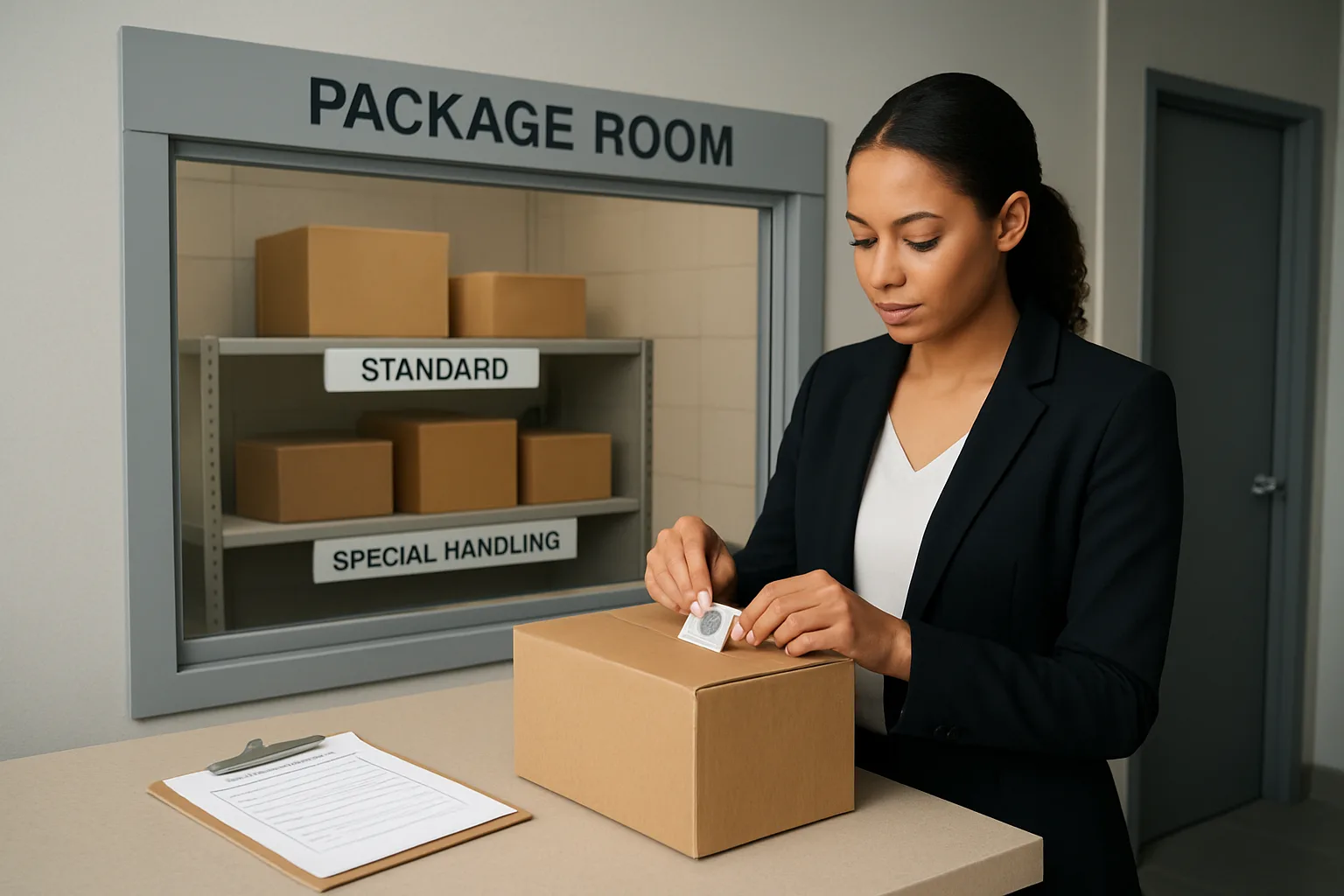
Operational Controls: Training, Audits, and the Chain-of-Responsibility Package Room
A high liability package handling policy apartment building teams can actually follow lives or dies on operational controls. The goal is not to build a courtroom-ready chain-of-custody; it is to create a consistent chain-of-responsibility package room model where every handoff has one accountable person, every exception has one reason code, and staff do not improvise under pressure.
If you can answer three questions at any moment, your SOP is working: Who accepted it, where is it right now, and who is allowed to release it? The controls below keep those answers simple, repeatable, and defensible for controlled substances delivery policy edge cases, perishable package procedure decisions, and adult signature deliveries front desk scenarios.
- Operating principle: assign responsibility to roles, not individuals. (Coverage changes; responsibilities should not.)
- Default to the smallest number of access points. The fewer people who can open secure storage or override policy, the fewer disputes you will manage.
- Train for the moment of pressure: a carrier insisting, a resident demanding an exception, or a handoff happening during a rush.
- Audit the process, not the people: spot patterns and fix triggers, signage, and staffing gaps.
- Keep documentation minimal and consistent: when controls are strong, you need fewer notes to resolve issues.
Role clarity: who can accept, who can log, who can access secure storage, who can override
Define four roles and publish them in the front-desk SOP binder (and in your internal knowledge base). Staff should never have to guess who is authorized to do what, especially for adult signature deliveries front desk interactions or any package that appears to fall under a controlled substances delivery policy boundary.
Recommended role split (adjust for your building’s staffing model):
1) Receiver (front desk/security on duty): may accept only packages that meet the decision tree accept criteria; may decline/redirect without manager approval when a trigger is hit. Receiver never signs as the resident and never performs ID verification beyond confirming the resident is present for their own pickup (if your policy allows resident-present signing workflows). 2) Logger: performs scan-in/QR-label application and assigns a storage location; may be the same person as Receiver on low-volume shifts, but the action is distinct. 3) Custodian (secure storage access): holds the key/code for lockable cabinet or restricted shelf; releases items per scan-out rules; documents exceptions. 4) Supervisor/Manager (override authority): approves rare exceptions (for example, a one-time redirect plan when a resident with mobility limitations cannot meet a carrier) and documents a short reason code.
Shift-change handoff checklist: pending pickups, exceptions, temperature-sensitive holds, carrier callbacks
Most losses and disputes happen at shift change. Use a two-minute handoff that focuses on what is different today, not a recap of everything in the room. If your team uses scanning/QR labels, the handoff is a quick review of flags and exceptions rather than re-counting inventory.
A practical shift-change handoff checklist:
– Pending high-liability holds: list unit numbers only (not contents), storage locations, and any pickup deadlines (for example, perishable time limits). – Exceptions in progress: declines/redirects that may trigger resident follow-up or carrier return attempts. – Temperature-sensitive items: anything accepted under a perishable package procedure exception (if allowed) with the cutoff time and the escalation contact. – Carrier callbacks: any promised call-backs to a carrier dispatch or driver, with the contact number and reference note. – Access status: confirm who has the secure storage key/code for the next shift and verify it transfers person-to-person (no leaving keys in drawers). – Package room condition: door locked, signage in place, bins not overflowing, and any damaged/leaking isolation area cleared or tagged.
Secure storage setup: designated bins, lockable cabinet, signage, and access control basics
Your physical setup is part of your policy. If you do not have secure or appropriate storage, the correct control is to decline/redirect at the door rather than “make it work” inside the building. The environment should make compliant behavior the easiest behavior.
A simple, defensible setup that supports a chain-of-responsibility package room:
– Zoned shelves/bins: clearly labeled areas such as Standard, Oversize, Pending Pickup Today, and Exceptions/Do Not Accept (for items awaiting carrier retrieval). Avoid labels that imply content categories (for example, “Medication”) to reduce privacy issues. – Lockable cabinet or cage: used for any item your policy allows but wants restricted access for (for example, high-value electronics or resident-requested holds). Keep access limited to the Custodian role. – Isolation bag/bin: for damaged/leaking/odor items awaiting carrier pickup; keep it separate from general packages. – Single intake point: one counter or cart where items are scanned and labeled before they touch a shelf. This prevents “I set it down for a second” losses. – Signage at the desk and package room door: short rules that mirror your policy boundary (no refrigeration, no resident signature, redirect options). – Access controls: a log or system record of who accessed secure storage and when (scan-in/scan-out covers most of this; if not, a simple key sign-out sheet is sufficient).
Audit rhythm: weekly spot checks and quarterly policy review for patterns (repeated exceptions, problem carriers, bottlenecks)
Audits should be light-touch and predictable. The purpose is to catch drift: staff slowly making exceptions, storage zones becoming messy, or carriers pushing the desk into unofficial acceptance behaviors.
Weekly spot checks (10–15 minutes):
– Walk the shelves: verify items match their labeled zones and nothing is unscanned. – Check secure storage: confirm only authorized items are inside and access is controlled. – Review exceptions log: count how many declines/redirects happened and why (one-line reason codes are enough). – Scan a sample: pick 5–10 items and confirm scan-in has a storage location and scan-out is occurring at pickup. – Check signage: ensure the rules residents and carriers see match the current SOP (no outdated promises like “we accept all packages”).
Quarterly review (30–60 minutes with manager + lead concierge/security):
– Pattern check: repeated exceptions by the same carrier, same unit, or same time of day (often signals staffing or signage issues). – Bottleneck check: frequent after-hours drops, overcrowded shelves, or frequent “recipient unclear” events (often signals labeling/QR workflow gaps). – Policy boundary stress-test: confirm the controlled substances delivery policy boundary, perishable package procedure limits, and adult signature deliveries front desk stance still match your storage capacity and staffing. – Update the decision tree triggers and scripts based on what staff actually sees (for example, recurring third-party courier behavior).
Incident response workflow: lost item claims, misdeliveries, and resident complaints without over-documenting
When something goes wrong, the fastest way to reduce liability is to respond consistently and stick to facts. Avoid creating new obligations (for example, “we’ll reimburse” or “we’ll investigate the carrier”) in the heat of the moment. Your workflow should focus on locating the item, confirming what happened in your logs, and routing the resident to the correct next step with the carrier.
A pragmatic incident response flow:
1) Verify identity and basics: confirm unit number and delivery date window; pull the scan/log entry (or confirm there is none). 2) Check the last known location: shelf/bin location from the log, secure cabinet access record, and scan-out record if released. 3) Physical sweep in a defined order: intake counter, oversize area, exception/isolation bin, and any “pending pickup today” zone. 4) If misdelivery is likely: document one note (“item not located; no scan-out; searched zones A–D”) and advise resident to open a carrier claim or contact sender; provide your building’s standard letter language if you use one. 5) If a staff error is confirmed (for example, wrong unit scan-out): escalate to supervisor; do not debate at the desk; record only facts and the corrective action taken. 6) Close the loop: once resolved, add a brief final status to the incident note (found/released to unit X/returned to carrier). Keep it short to avoid inconsistent storytelling later.
Continuous improvement: refine triggers and scripts based on what staff actually sees at the door
The strongest SOP is the one your team can execute on a busy Tuesday. Build a small feedback loop so the decision tree and scripts stay aligned with reality, especially as carrier practices and third-party couriers change.
Make continuous improvement routine, not a special project:
– Create a “two-line feedback” rule: staff can submit a quick note after an incident or repeated friction point (example: “Courier X leaves adult-signature boxes anyway; no signature prompt shown; happens after 7pm”). – Update triggers when you see repeat confusion: if staff cannot reliably identify perishables, adjust accept rules to focus on storage capability rather than label interpretation. – Refresh scripts quarterly: keep them short, consistent, and carrier-friendly. The best script is one staff will actually say under pressure. – Retrain with short drills: run a five-minute scenario at shift start once a month (carrier insists, resident upset, after-hours drop). – Validate the physical system: if shelves overflow or secure storage is too small, your policy boundary must tighten (decline/redirect earlier) until capacity improves. Consistency beats optimism in high-liability handling.
Frequently Asked Questions
What should our high-liability package handling policy apartment building teams use as the default: accept or decline?
Default to decline/redirect for anything that requires specialized handling you cannot consistently provide (secure controlled storage, refrigeration, or identity verification). A defensible policy is built around one principle: only accept what you can store safely and release with a clear chain-of-responsibility. If your desk or package room cannot meet those conditions every day, make the default “redirect to resident or carrier hold” and treat acceptance as the exception that must meet simple criteria (clear recipient, appropriate storage available, fast pickup window, and no staff signing beyond policy).
How do we handle “ambiguous” deliveries that might be controlled substances without guessing what’s inside?
Treat ambiguity as a handling category, not a content determination. If the label or carrier workflow indicates regulated handling (examples: “Rx,” pharmacy shipper branding, “restricted,” “adult signature,” “temperature sensitive,” “deliver to patient,” or a carrier prompt that implies legal/ID requirements), apply your controlled substances delivery policy: redirect to the resident directly, require resident-present handoff, or instruct the carrier to hold-at-location.
Do not record suspected contents or medical details. Log only the observable trigger (for example: “carrier required resident signature” or “shipper marked restricted”) and the action taken (redirect/decline). If the resident disputes it, your response stays operational: “We’re not authorized to accept items that require regulated handling unless the resident is present.”
If we have a fridge in the office, can we accept perishables sometimes?
Only if you can do it consistently, access is controlled, and the pickup window is short. A perishable package procedure that relies on “sometimes” is where disputes and spoilage claims start.
A pragmatic approach:
– Accept only if the package is clearly addressed to a current resident, intact, and you have space in a designated, labeled bin.
– Set a strict hold limit (example: must be picked up by end of day or within a defined number of hours) and make it resident-visible in your notice.
– No rebagging, no transferring contents, no temperature promises (“stored as a courtesy, not guaranteed”).
– If the fridge is shared with staff items or is unlocked/unmonitored, do not use it for resident deliveries. Redirect to unit door delivery, locker/refrigerated service (if available), or carrier hold.
This keeps your process aligned with “accept only what you can store safely,” rather than turning staff into food handlers.
What’s the safest approach to adult signature deliveries front desk teams see every day (alcohol, vape, certain electronics)?
Pick one of these models and apply it consistently:
Model A: No-sign policy (simplest)
– Staff do not sign for any adult-signature packages.
– Carrier must deliver to the resident directly or hold-at-location.
– Front desk can help by calling/texting the resident when the carrier is present (but does not take custody).
Model B: Resident-present signing workflow (controlled exception)
– Staff may facilitate the handoff only when the resident is physically present.
– Staff do not verify ID unless your legal counsel and property policy explicitly require it (and if so, never record ID numbers).
– The carrier completes the ID check and signature with the resident; staff only witnesses the transfer at the desk.
Model C: Scheduled delivery window
– Building publishes limited hours when resident must be present for signature-required items.
– Outside that window, carriers are instructed to hold.
Whichever model you choose, document the rule in one sentence and train staff to repeat it verbatim. Inconsistency (“we did it last time”) is what creates resident conflict.
What is the minimum documentation that actually helps in a dispute without creating a complicated chain-of-custody?
Use a “minimum record” that proves three things: when you had it, where it was, and who released it. A workable set:
– Date/time received
– Unit and resident last name/initial (as your system allows)
– Carrier
– Category tag (standard, perishable, adult-signature, restricted, unknown special handling)
– Storage location (shelf/bin/cabinet identifier)
– Handler initials (received and released)
Add a photo only when it reduces argument: visible damage, leaks, missing/illegible label, or when a supervisor approves an exception. Avoid photos of anything that reveals private information beyond the shipping label. Keep exception reasons as simple codes (example: “DECLINE-AS: adult signature required,” “REDIRECT-NS: no secure storage,” “DECLINE-DMG: leaking”).
This supports a chain-of-responsibility package room process without pretending you’re maintaining legal chain-of-custody for regulated goods.
How do we respond when a carrier insists “the building always takes these,” or a resident pressures staff to bend the rules?
Treat it as a scripting and escalation problem, not a negotiation.
Carrier-facing script (calm, repeatable):
– “We can’t accept items that require resident signature, regulated handling, or refrigeration. Please deliver to the resident or mark hold-at-location.”
– If pushed: “Our policy is consistent across shifts. If you need a point of contact, please note the property manager’s email/phone listed on our delivery instructions.”
Resident-facing script (boundary + help):
– “We can’t take custody of that category at the desk. The fastest option is carrier hold for pickup, or scheduling delivery when you’ll be home. If you’d like, we can share the exact delivery instructions to add to your account.”
Escalation rule:
– Front desk does not “make exceptions” under pressure. Exceptions, if allowed at all, require manager approval and a one-line log reason.
This protects staff, prevents uneven treatment, and keeps the conversation focused on what the building can operationally support instead of debating legality or contents.
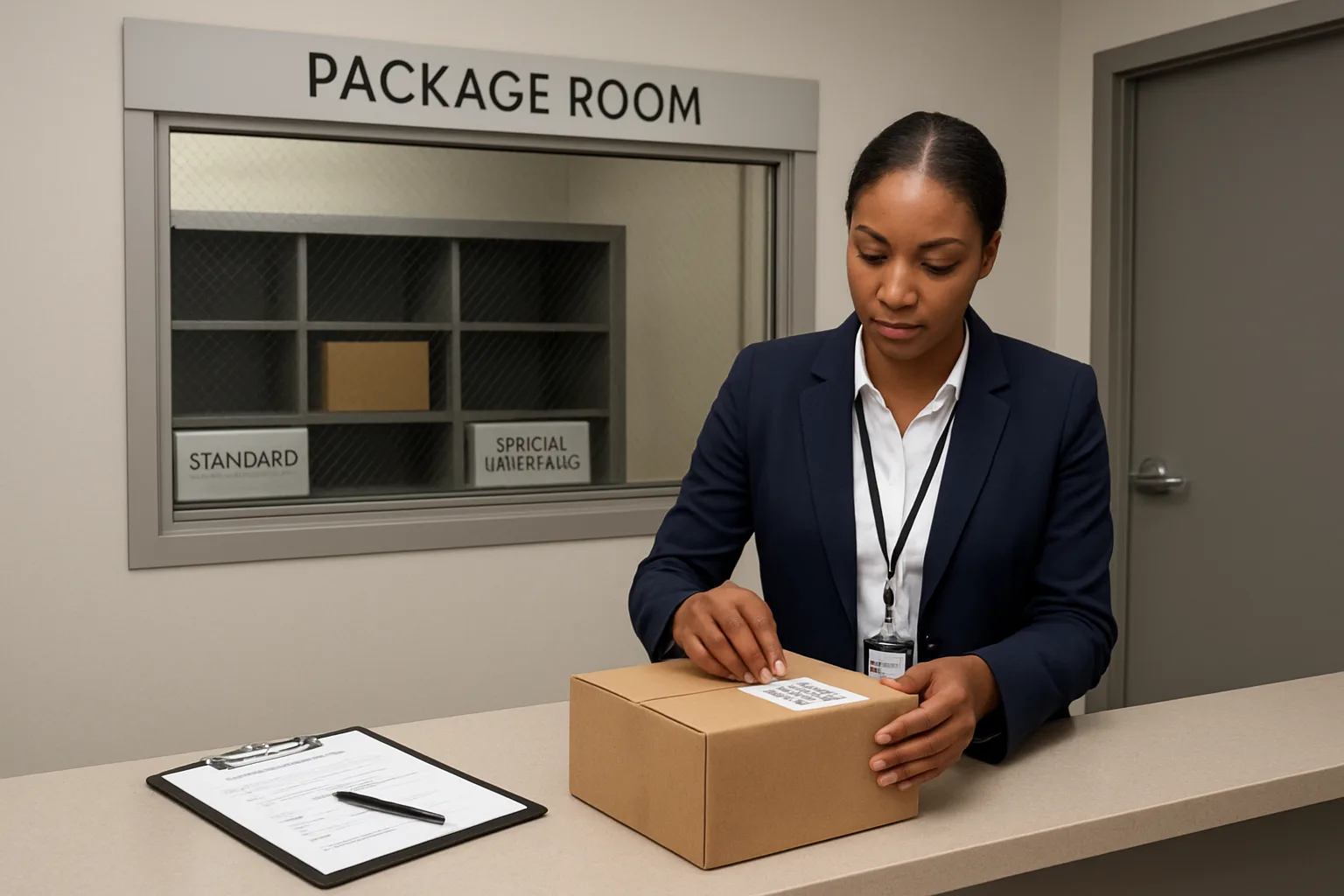
Requested CTA
A Simple Rule Keeps You Out of Trouble: Only Accept What You Can Control
The safest operating principle for high-liability deliveries is uncomplicated: if you cannot store it securely (or appropriately), and you cannot hand it off with a clear chain-of-responsibility package room process, you should not accept it. That is not “bad service”—it is a clear boundary that prevents inconsistent exceptions, staff pressure, and avoidable disputes.
A usable SOP is also a minimal one. Log only what you need to run the operation: who handled it, when, what category it was tagged as, where it was placed, and how it left the building. Use QR-label scanning and simple reason codes for declines/redirects to spot patterns, not to create a fragile paper trail that becomes a problem when it is incomplete. Avoid recording sensitive assumptions about contents, health information, or ID details you do not need.
Finally, keep your policy human. Residents usually cooperate when expectations are specific and consistent: what the building can accept, what it will redirect, what pickup windows apply, and what to do instead (carrier hold, scheduled delivery, delivery to unit, alternate pickup locations). Review exceptions quarterly—what staff are seeing at the door will change—and adjust triggers and scripts so the policy stays easy to follow on a busy shift.